

otitis
 3
7.9
3
7.9

- noun
- /oʊˈtaɪtɪs/
- Specialized
- Patients with chronic otitis media, with or without cholesteatoma, comprised the largest group in this study.
- otitis media
- chronic otitis
- acute otitis
Examples
-
A 55-year-old, immunocompromised man presented with a history of chronic left otitis media and multiple recurrent tympanic membrane perforations.
Academic text (2008) -
Because there is clearly an infectious component to chronic external otitis, antibiotics do play a role.
Academic text (2001) -
Women are more affected by chronic external otitis than men by a ratio of 2:1.
Academic text (2001) -
In 1949, when the patient was 37 years old, she developed otitis media in the left ear.
Academic text (2001) -
Following the removal of the foreign body, his health improved, the otitis media cleared up, and he gained weight.
Academic text (1996) -
In rare cases, chronic external otitis is a manifestation of an id reaction.
Academic text (2001) -
Additional head and neck findings included otitis media (6%), epistaxis (6%), and sinusitis (6%).
Academic text (1995) -
Otologic examination revealed bilateral chronic otitis media with abundant, stringy, mucopurulent discharge and extensive destruction of both tympanic membranes.
Academic text (1996) -
Many children experience otitis during their early years due to frequent colds.
-
The doctor recommended a follow-up appointment to check for any complications from the otitis infection.
Compounds
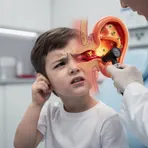
- Specialized
2
4.7
An infection in the middle ear, often in children, that causes ear pain and trouble hearing

- Specialized
An infection or swelling of the outer part of the ear that causes pain, redness, and discharge

How Severe
- Specialized
3
7.9
 6
1.3
6
1.3
Surface Forms
Morphology
otitis = ot + itis
The term is built from the medical combining form 'ot-' (ear) + '-itis' (inflammation), but 'ot-' is not a standalone English word and the medical suffix is specialized, so learners cannot reliably derive 'inflammation of the ear' from the visible parts.
Etymology
Otitis comes from the root ot- meaning 'ear' and the ending -itis meaning 'inflammation'. You see the same -itis in tonsillitis and arthritis, so otitis means 'inflammation of the ear'.