

orbital rotation
- noun
- /ˈɔrbɪtəl roʊˈteɪʃən/
- Specialized
- The Moon's orbital rotation around the Earth takes approximately 27 days.
Examples
-
Jupiter's rings maintain their shape due to the orbital rotation of countless tiny particles.
-
Engineers calculate the orbital rotation of satellites to ensure they remain in stable orbits.
-
The orbital rotation of Earth takes approximately 24 hours.
-
Saturn's orbital rotation is unique among the planets.
-
Engineers calculate the orbital rotation of satellites to ensure they remain in stable orbits.
-
The Moon's orbital rotation around the Earth takes approximately 27 days.
-
The orbital rotation of Earth takes approximately 24 hours.
Synonyms

 378
4.0
378
4.0

A curved path that a planet or satellite follows around another body
 45
3.5
45
3.5
One complete turn around a central point, like a planet or wheel


 1
5.3
1
5.3
Movement of one object around another in space, like a planet around a star

One complete turn, like a wheel or a dancer
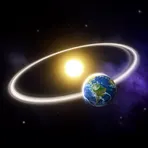
A path in space that a planet or moon follows around a bigger object such as a star
Surface Forms
Morphology
The phrase is a straightforward ADJ+NOUN composition: 'orbital' (relating to an orbit) modifies 'rotation' (a turning/movement), so the combined meaning — rotation or movement occurring in an orbital path — is directly inferable from the parts. This compositional pattern is common across languages and does not require specialized idiomatic knowledge, so a B1 learner who knows both words can reasonably deduce the meaning.
Etymology
Orbital rotation comes from the simple image of a ball on a string swung around a post. The word orbit is the path around something and rotation is the turning motion, so the phrase means 'the motion of an object moving in a curved path around another body', like a planet going around a star.