
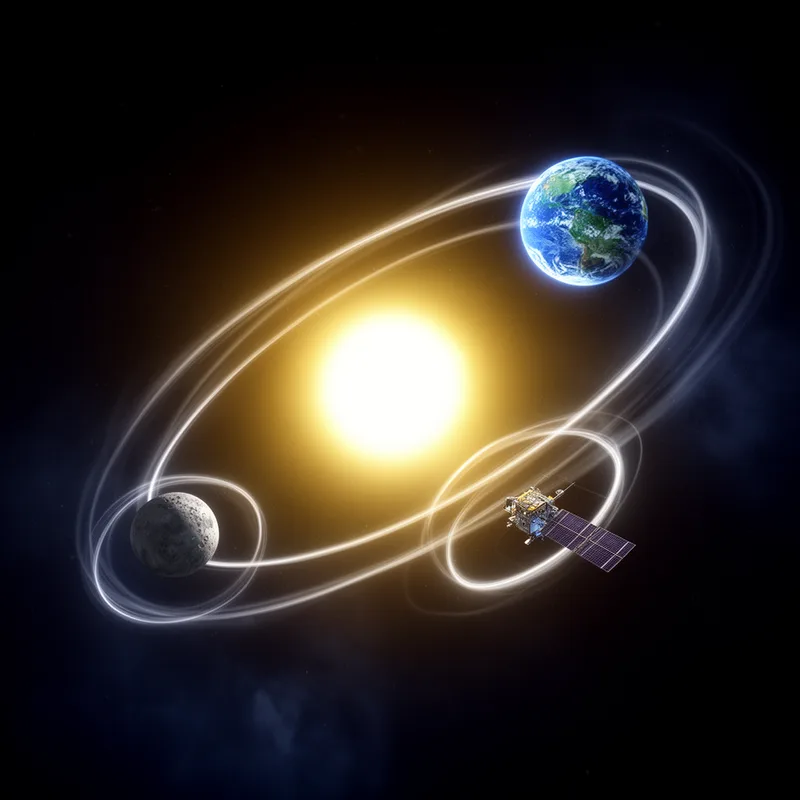
orbital motion


 1
5.3
1
5.3
- noun
- /ˈɔrbɪtəl ˈmoʊʃən/
- Specialized
- As Earth continues its orbital motion around the Sun, we experience changing seasons throughout the year.
- Earth's orbital motion
Examples
-
The usual way these close binaries are detected is with a spectrometer: the orbital motions produce Doppler shifts in spectral lines to the blue (for approach) or red (for recession), and the faster the stars' motions, the greater the shift.
Academic text (1999) -
But the closer a planet lies to the Sun, the faster its orbital motion.
Academic text (2005) -
The period would regularly rise and fall due to the orbital motion.
Academic text (2001) -
The planet's orbital motion away from Earth brings big changes to its telescopic appearance.
Academic text (2004) -
Their normal orbital motion brings them relatively near the Earth at intervals of a few years, permitting their discovery.
Academic text (1992) -
As the orbital motion brings ring particles toward the moon, its gravitational tug increases their orbital radius.
Academic text (1995) -
In addition, the rate of mass transfer, and hence the X-ray brightness, can vary in synchrony with the orbital motion of the companion.
Academic text (1990) -
Formed by gravitational collapse and flattened by orbital motion around their central star, the disks typically have sizes comparable to that of the Solar System or larger.
Academic text (2005) -
In the late 17th century, Isaac Newton solved what was then known as "the two-body problem," describing the orbital motion of one celestial body, such as a planet, about another body, such as the Sun.
Academic text (2005) -
By studying the motions of pulsars in binary systems, astronomers have observed precisely this effect and have seen the orbital motion change in precisely the way that Einstein's theory predicts.
Academic text (1991)
Synonyms
 378
4.0
378
4.0
A curved path that a planet or satellite follows around another body
 45
3.5
45
3.5
One complete turn around a central point, like a planet or wheel

An object moving in a curved path around another object, not spinning on itself

A path in space that a planet or moon follows around a bigger object such as a star
Surface Forms
Morphology
The meaning 'movement of an object along a curved path around a fixed point' is directly and transparently derived from combining 'orbital' (relating to orbits/paths of celestial bodies) with 'motion' (movement). This adjective+noun composition follows normal English compositional patterns and is cross-linguistically common, so a B1 learner who knows the constituents would readily understand the MWE.
Etymology
Orbital motion gives a simple picture: orbital means a ring-like path and motion means movement. So it refers to 'movement along a curved path around a fixed point', like a satellite going around the Earth.