

oral herpes
- noun
- /ˈɔrəl ˈhɜrpiːz/
- Specialized
- Genital herpes is not going to travel to your mouth, and oral herpes is not going to travel to your genitals.
Examples
-
Since you have a history of cold sores, then it's safe to say that your herpes is probably oral herpes type 1.
Blog text (22) -
As long as you don't have oral herpes.
-
It's possible for a person to have both oral herpes and genital herpes.
Blog text (22) -
Both oral herpes and genital herpes are caused by the herpes simplex virus (HSV).
Academic text (2005) -
As long as you don't have oral herpes, you can safely share drinks with your friends.
-
It's possible for a person to have both oral herpes and genital herpes.
-
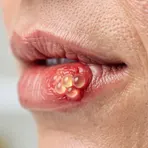
If you notice sores on your lips, it could be a sign of oral herpes caused by the HSV-1 virus.
Synonyms
 14
4.5
14
4.5

A virus that causes painful blisters on the skin, often near the mouth or genitals
 8
3.2
8
3.2
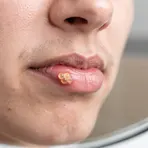
Small painful blisters on the lips or around the mouth that a virus causes


 1
5.1
1
5.1
A small painful sore on the lip or face caused by the herpes virus

A viral infection that causes painful blisters on the lips or around the mouth

An infection that causes small painful blisters on the skin or in the mouth

A virus that causes painful blisters on the mouth or private parts
How Symptomatic
8
3.2

- Specialized
Surface Forms
Morphology
The term combines 'oral' (pertaining to the mouth) with 'herpes' (a viral illness causing sores), so its meaning — herpes infection around the mouth — is directly derivable from the constituents. Medical compound naming is cross-linguistically common, making this readily understandable to a B1 learner who knows both words.
Etymology
Oral herpes starts as a literal label: oral means about the 'mouth' and herpes comes from an old word meaning 'to creep', a picture of blisters that can appear and come back around the mouth. So oral herpes refers to a viral infection that causes sores or blisters around the mouth and can spread to other people.