
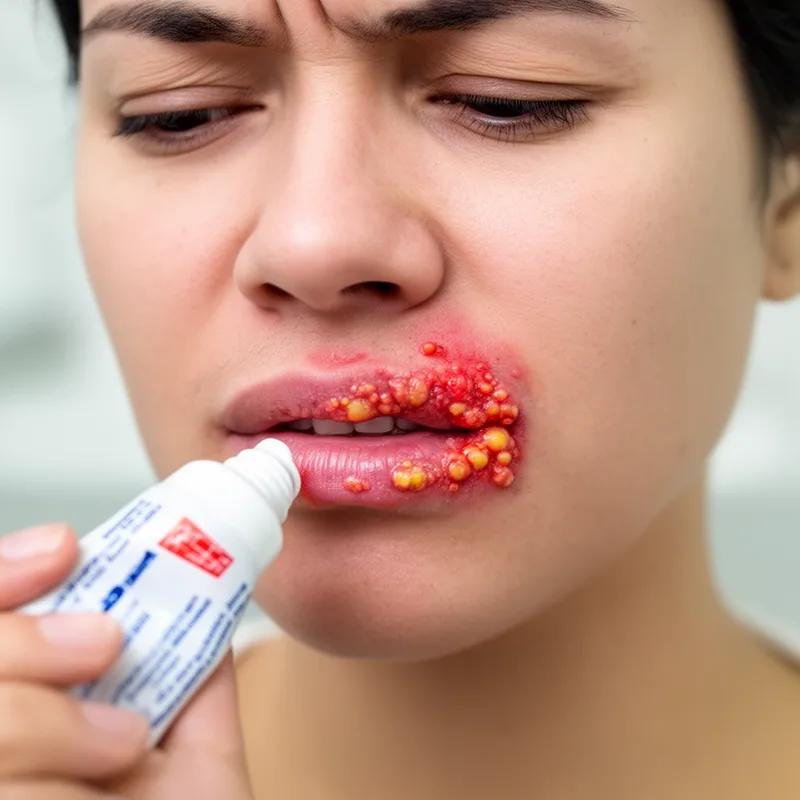
herpes labialis
- noun
- /ˈhɜr.piz ləˈbeɪ.li.əs/
- Specialized
- To avoid triggers, it is essential for those prone to herpes labialis to protect their lips from excessive sunlight.
- recurrent herpes labialis
- recurrence of herpes labialis
- sun-induced herpes labialis
Examples
-
At the six-month follow-up, no adverse effects of UV exposure were noted, and 15 of 30 patients reported recurrence of herpes labialis since completion of the study.
Academic text (1991) -
Sunlight triggers herpes labialis in up to a quarter of people with recurrent infections.
Academic text (1991) -
In the immunocompromised host, herpes labialis can be severe.
Academic text (1991) -
Our results indicate that the recurrence rate of herpes labialis can be reduced by the use of sunscreens.
Academic text (1991) -
No outbreaks of herpes labialis were noted in the second or third weeks after UV exposure.
Academic text (1991) -
Sunlight exposure is reported by some patients to precede the onset of recurrent herpes labialis.
Academic text (1991) -
Since the likelihood of reactivation was independent of previous rates of recurrence or reported history of sun-induced herpes, our data suggest that all patients with a history of herpes labialis might benefit from applying sunscreens when long exposure is expected.
Academic text (1991) -
About 150 million Americans have latent herpes simplex virus (HSV) type 1 infection, accounting for 100 million episodes of recurrent herpes labialis each year.
Academic text (1991) -
Herpes labialis causes painful blisters that can appear on the lips and around the mouth.
-
Many people experience outbreaks of herpes labialis, commonly known as cold sores, during stress or illness.
Synonyms
 8
3.2
8
3.2

Small painful blisters on the lips or around the mouth that a virus causes

 1
5.1
1
5.1
A small painful sore on the lip or face caused by the herpes virus

A contagious infection that causes painful cold sores on or around the lips
Surface Forms
Morphology
herpes + labialis
The term combines 'herpes' (a viral eruption) with the Latin-derived element 'labialis' meaning 'pertaining to the lips', so the sense 'herpes of the lips' is compositionally derivable for learners who recognize the labial/root. However, 'labialis' is a specialized medical/Latin form not familiar to most B1 learners, so understanding requires morphological or medical knowledge and is only partly predictable.
Etymology
Herpes labialis comes from old words: herpes meant 'to creep' on the skin and labialis means 'of the lip'. So the name shows a skin problem on the lip — a 'cold sore' with small painful blisters.