

herpes simplex
- noun
- /ˈhɜrpiːz ˈsɪmplɛks/
- Specialized
- The doctor confirmed that the painful blisters were caused by herpes simplex.
Examples
-
Antiviral medication can help reduce the frequency of herpes simplex outbreaks.
-
Many people are unaware that herpes simplex can also infect the eyes.
-
She was diagnosed with herpes simplex last year.
-
The herpes simplex virus can cause painful blisters.
-
Antiviral medication can help reduce the frequency of herpes simplex outbreaks.
-
The doctor confirmed that the painful blisters were caused by herpes simplex.
-
Many people are unaware that herpes simplex can also infect the eyes.
Synonyms
 8
3.2
8
3.2

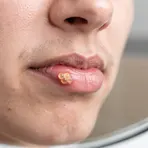
Small painful blisters on the lips or around the mouth that a virus causes

 1
5.1
1
5.1
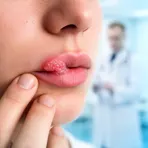
A small painful sore on the lip or face caused by the herpes virus

A viral infection that causes painful blisters on the lips or around the mouth

A contagious infection that causes painful cold sores on or around the lips
Surface Forms
Morphology
The term is compositional in that 'herpes' signals the class of viral infection and 'simplex' marks a specific subtype, so a learner who knows 'herpes' will likely infer this is a particular kind of herpes. However, 'simplex' is a technical/Latin label whose contribution to the clinical meaning (symptoms, oral vs. genital, viral cause) is not transparent to a B1 learner, making the overall expression only partially predictable without prior exposure.
Etymology
Herpes simplex takes its name from herpes, an old word meaning 'to creep', because the painful blisters can appear to crawl or spread along the skin. The second part, simplex, means 'simple' or 'single' to mark it as the usual, not-complicated form, which is why the name now describes the viral infection with small blisters.