

occipital lobe
 4
7.0
4
7.0

- noun
- /ɑˈksɪpɪtəl loʊb/
- Specialized
- I can't determine occipital lobe swelling without a complete MRI.
Loading YouTube…
Watch on YouTubeSo you don't see with your eyes, you see with your occipital lobe, you don't hear with your ears, you hear with your auditory cortex.
- So you don't see with your eyes, you see with your occipital lobe, you don't hear with your ears, you hear with your auditory cortex.
Examples
-
They squeeze the carotid artery and restrict blood flow to the occipital lobe.
-
After leaving the lateral geniculate bodies, the information then travels along the visual pathways in the temporal and parietal lobes, ending in the occipital lobe.
Academic text (1994) -
So it's very clear that this occipital lobe back here is largely concerned with vision.
-
I thought maybe the accident had damaged her occipital lobe and her vision was impaired as well!
Blog text (14) -
Actually, Matthew had a cluster of malformed veins in the occipital lobe of his brain, but they did not know about it until much later.
Fiction book (1996) -
So you don't see with your eyes, you see with your occipital lobe, you don't hear with your ears, you hear with your auditory cortex.
-
He sees, for example, that the occipital lobe in that brain has been damaged, or that taking Prozac has caused the brain to display increased levels of serotonin.
Academic text (2017) -
Forward there is the frontal lobe, easy to remember this part in front, the parietal lobe, the occipital lobe, and the temporal lobe.
-
It is here that formed vision is interpreted, and through areas called the visual association areas immediately in front of the occipital lobes, the information is appropriately interpreted and correct actions can be initiated (Livingstone 1988).
Academic text (1994) -
The occipital lobe is at the back of your brain and is crucial for interpreting visual information.
Synonyms
 4
5.7
4
5.7
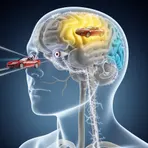
Part of the brain at the back that turns signals from the eyes into what you see
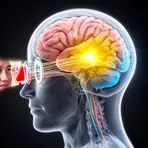
Part of the brain at the back of the head that processes what you see
Surface Forms
Morphology
The compound is fully compositional: 'occipital' (relating to the back part of the skull) plus 'lobe' (a rounded projecting part of an organ) yields 'the lobe at the back of the brain', so a learner who knows the constituents can infer its referent and location. Although the specific function (visual processing) is specialized anatomical knowledge, the structural meaning is directly derivable and cross-linguistically transparent.
Etymology
The term occipital lobe comes from words meaning 'back of the head' for occipital and 'rounded part' for lobe. This area sits at the back of the brain and mainly handles vision, so the name points to its place and job.