
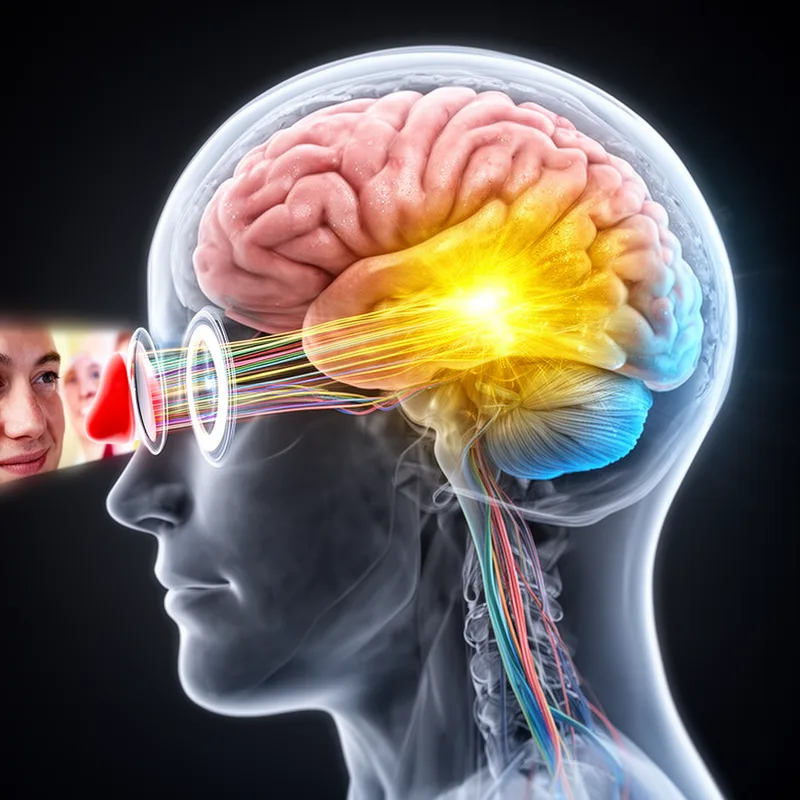
occipital cortex
- noun
- /ɑˈkɪpɪtəl ˈkɔrˌtɛks/
- Specialized
- Damage to the occipital cortex can lead to significant visual impairments, affecting a person's ability to see clearly.
Loading YouTube…
Watch on YouTubeOK, Where with the visual areas back here, this is called the occipital cortex, right?
- OK, Where with the visual areas back here, this is called the occipital cortex, right?
Examples
-
As this white light extends, it increases to involve the entire occipital cortex and, thus, the entire visual field.
Academic text (1994) -
Various modules in the occipital cortex modulate raw input from the optic nerves to discriminate color, contrast, and boundaries.
Blog text (26) -
Neuroimaging studies should allow us to test whether cross-modal recruitment of the occipital cortex can be observed during olfactory tasks in persons with early-onset blindness.
Academic text (2010) -
The occipital cortex plays a crucial role in how we perceive colors and shapes in our visual field.
-
Researchers discovered that the occipital cortex is active even when we are not consciously processing visual stimuli.
Synonyms

 4
7.0
4
7.0

Part of the brain at the back that helps you see
 4
5.7
4
5.7
Part of the brain at the back that turns signals from the eyes into what you see

A part of the brain that receives and processes images from the eyes
Surface Forms
Morphology
The compound is directly compositional: 'occipital' denotes the back part of the skull and 'cortex' denotes the brain's outer layer, so a learner who knows both constituents can infer 'the cortex at the back of the head' and its association with vision. Although the term is technical, this anatomical naming pattern is regular and cross-linguistically common, making the meaning transparent to learners familiar with the parts.
Etymology
Occipital cortex comes from Latin words: occiput meaning 'back of the head' and cortex meaning 'outer layer'. So the name points to the brain's outer part at the back that is used for 'vision'.