
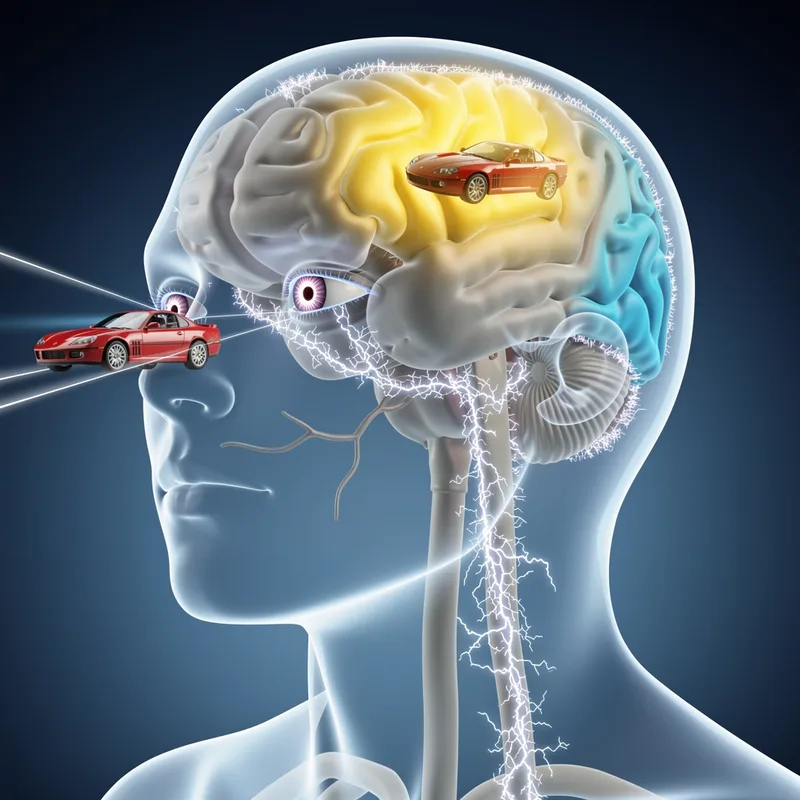
visual cortex
 4
5.7
4
5.7

- noun
- /ˈvɪʒuəl ˈkɔrtɛks/
- Specialized
- Information from the visual cortex is then routed to the temporal lobes, which handle object recognition.
- the primary visual cortex
- the visual cortex in the brain
Loading YouTube…
Watch on YouTubeThey don't do it as newborns because their visual cortex isn't working fast.
- They don't do it as newborns because their visual cortex isn't working fast.
- So can you speak to stimulating the visual cortex?
- And then just a couple months ago, this group found a way to use machine learning to translate the visual cortex activity into images.
- Before us was a cat under general anesthesia, with an array of electrodes carefully inserted into its visual cortex.
- Before us was a cat under general anaesthesia, with an array of electrodes carefully inserted into its visual cortex.
- Could be within the eye, but more technically it's going to be done within the deeper brain, OK, Areas like the thalamus, the visual cortex for those that want to know.
- So there's, you know, a certain part of the visual cortex, for example, that's responsible for your experience of motion that gives motion to objects in the world.
- So I mean, I, I, we know quite a bit about what say the visual cortex represents.
- So vision visual cortex is not just a feed forward cascade of neurons.
- And those produce further such excitations in my visual cortex and yadda, yadda, yadda.
- And in part, it has to do with the fact that we have this visual cortex.
- Now, people who believe sort of perception is, is fundamentally what's in our human perception, the visual cortex and so on.
- So the the point is that you, you, all those of us who who see have representations of the visual world and our visual cortex.
Examples
-
Damage to the visual cortex can lead to difficulties in recognizing faces and objects.
-
If the signals are disrupted on their way to the visual cortex, or the light is not properly converted, blindness results.
Academic text (2003) -
And then just a couple months ago, this group found a way to use machine learning to translate the visual cortex activity into images.
-
What we see here is the list of all the pre attentive visual attributes that our visual cortex is able to quickly spot.
-
Predictive coding is a theoretical framework that describes the function of sensory processing in general and the visual cortex in particular.
Academic text (2017) -
With Dobelle's procedure, a 16-electrode plate is implanted on a patient's visual cortex.
Academic text (2003) -
So there's, you know, a certain part of the visual cortex, for example, that's responsible for your experience of motion that gives motion to objects in the world.
-
Example: If I ask you a question about something visual, like your favorite color... and your eyes go up and to the left... neurophysiology tells us that your eyes go that in that direction... because you're accessing the visual cortex.
-
They don't do it as newborns because their visual cortex isn't working fast.
-
And when we look at that sleep stage inside of the MRI scanner, first the vast swaths of the visual cortex start lighting up in your brain.
Synonyms

The part of the brain at the back that receives visual signals from the eyes

Part of the back of the brain that gets signals from the eyes for vision
The part at the back of the brain that first processes what you see

Part of the back of the brain that receives and starts to process signals from the eyes
Part of the brain at the back that first gets signals from the eyes
A part of the brain that receives and processes images from the eyes
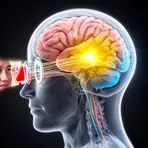
Part of the brain at the back of the head that processes what you see
How Visual
- Specialized
4
5.7

- Specialized
- Specialized
9
3.7
- Specialized
Surface Forms
Morphology
The meaning 'the part of the cortex that processes visual information' is directly and compositionally derived from 'visual' (related to sight) modifying 'cortex' (the brain's grey-matter layer). This modifier + noun combination is a transparent, cross-linguistically common naming pattern (e.g. Spanish 'corteza visual', French 'cortex visuel'), so a B1 learner who knows both constituents will readily infer the MWE's meaning.
Etymology
Visual cortex is a name that gives a clear picture: visual means 'seeing' and cortex means the brain's 'outer layer'. It sits at the back of the head and turns signals from the eyes into images, so the term refers to the part of the brain that helps us understand what we see.