
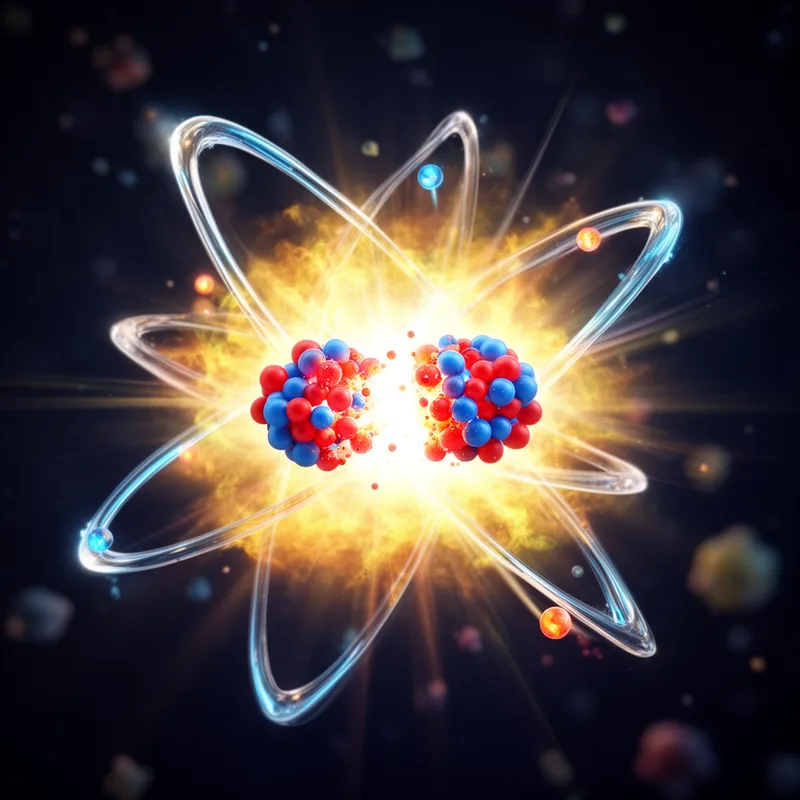
nuclear reaction
 4
4.4
4
4.4

- noun
- /ˈnjuːklɪər rɪˈækʃən/
- Specialized
- The rates of nuclear reactions depend on the density and temperature of the interaction medium.
- energy from nuclear reaction
- neutron-initiated nuclear reaction
- nuclear reactions release
Loading YouTube…
Watch on YouTubeThey literally stream out of the sun from these nuclear reactions.
- They literally stream out of the sun from these nuclear reactions.
- It was, it was Marty in science class learning about nuclear reactions.
Examples
-
Most citizens are concerned about nuclear reactions and their real and imagined consequences.
Academic text (1999) -
So the Sun has a lot of nuclear reactions that are happening in it, and those reactions can create neutrinos.
-
Power generation is a major use of nuclear reactions worldwide today.
Academic text (1999) -
In another lesson in science, students should be involved in modeling a nuclear reaction.
Academic text (1999) -
These rods actually control the nuclear reaction.
-
The chances of an uncontrolled nuclear reaction are near zero.
-
Objective: Students will describe people's perceptions of nuclear reactions when used for power generation.
Academic text (1999) -
William Fowler led a worldwide effort to make lab measurements of nuclear reactions important in stars.
Academic text (2001) -
The same set of nuclear reactions that supply the Sun's energy also produce neutrinos.
Academic text (2001) -
A nuclear reaction in the Sun fuses hydrogen atoms to create helium, releasing vast amounts of energy.
How Changed
- Specialized

 1
9.1
1
9.1

- Specialized
4
4.4
- Specialized
3
6.0
- Specialized
24
3.1
Surface Forms
Morphology
The phrase is directly compositional: 'nuclear' specifies the domain (atomic nuclei) and 'reaction' denotes a process, so a learner who knows both words can infer it means a process involving nuclei. While full technical details (e.g., energy release vs. chemical reactions) require specialist knowledge, the basic concept is transparent and cross-linguistically predictable.
Etymology
Nuclear reaction paints a simple picture: nuclear means the tiny center of an atom and reaction means something changing or reacting. So it means 'a change in an atom's center that gives off or takes in energy'.