

radioactive decay
 3
6.0
3
6.0

- noun
- /ˌreɪdiəʊˈæktɪv dɪˈkeɪ/
- Specialized
- The typical background counting rate for the counters corresponds to about one radioactive decay of a 37 Ar nucleus a month.
Loading YouTube…
Watch on YouTubeWe had less than one radioactive decay per day per ton of water in the centre of the detector, a billion times more pure than tap water.
- We had less than one radioactive decay per day per ton of water in the centre of the detector, a billion times more pure than tap water.
- You might wonder now, what's with radioactive decay?
Examples
-
Look for evidence that the changes in radioactive decay on Earth vary with the rotation of the sun.
Blog text (5) -
Neutrino: A neutral, phantomlike particle that is emitted during certain radioactive decay processes.
Academic text (1993) -
One can determine the age of space rocks like this from radioactive decay chains.
-
The helium that we have was produced by the radioactive decay of rock long ago.
Blog text (2) -
Tungsten-182, a rare isotope, arises from the radioactive decay of hafnium-182.
Academic text (2003) -
Instruments aboard the Gamma-Ray Observatory will examine the material that envelops known supernovae for gamma rays produced by radioactive decay.
Academic text (1990) -
The pioneering studies on the effect of variations of fundamental constants on radioactive decay rates were performed by James Peebles, Robert Dicke, and Freeman Dyson.
Academic text (2004) -
Scientists can measure the age of ancient rocks through radioactive decay processes.
-
The heat generated from radioactive decay is a source of energy deep within the Earth.
-
Many medical applications rely on radioactive decay to effectively treat certain diseases.
Synonyms
 53
7.8
53
7.8
The process when a radioactive atom changes and gives off radiation
 23
5.5
23
5.5
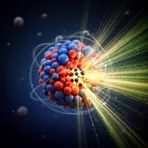
Release of tiny particles or rays from unstable atoms as they change
 2
7.8
2
7.8
A radioactive atom breaks apart and gives off radiation
Antonyms

How Energetic
- Specialized
4
4.2

- Specialized
4
4.9
- Specialized
3
6.0
- Specialized
24
3.1
Surface Forms
Morphology
The phrase is compositionally built: 'radioactive' (emitting radiation from unstable nuclei) modifies 'decay' (disintegration or breakdown), so a learner who knows both constituents can infer it refers to the decay process involving radioactivity. This technical term is a straightforward nominal combination and has clear cross-linguistic equivalents, making the meaning immediately derivable for B1 learners who know the words.
Etymology
Radioactive decay comes from a simple image: an unstable atom 'falling apart' and sending out invisible rays or tiny particles, with radioactive showing the rays and decay meaning to break down. So, radioactive decay means an atom losing energy by giving off radiation.