
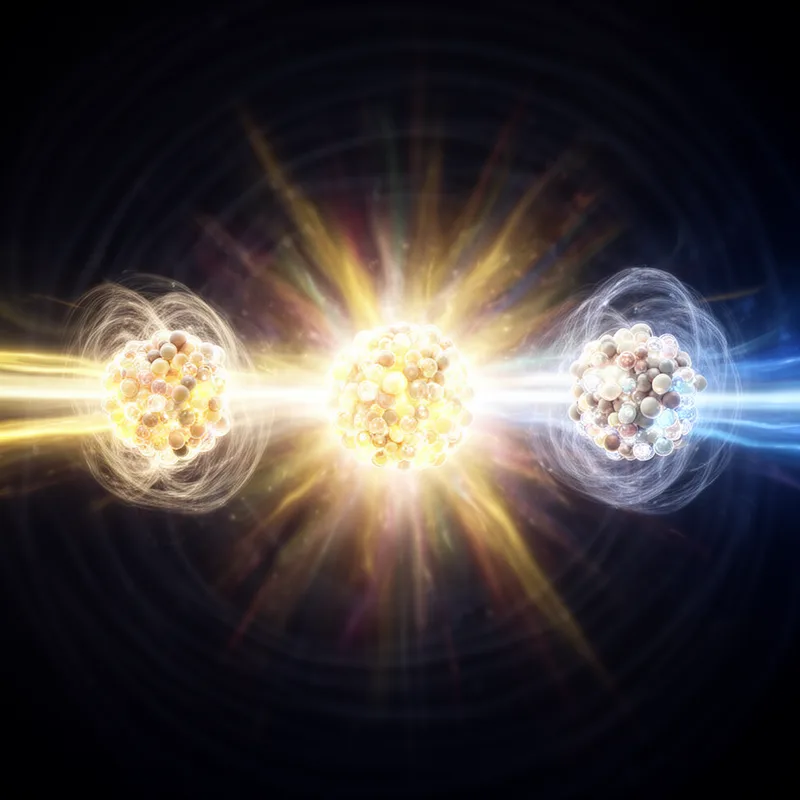
nuclear fusion reaction
- noun
- /ˈnjuːklɪər ˈfjuːʒən rɪˈækʃən/
- Specialized
- The sun generates heat and light through a nuclear fusion reaction that fuses hydrogen into helium.
Loading YouTube…
Watch on YouTubeAnd it's only in very hot states that nuclear fusion reactions take place.
- And it's only in very hot states that nuclear fusion reactions take place.
- I've little doubt that they can generate nuclear fusion reactions in their devices, but I strongly doubt that they're anywhere near break even.
- Then, through a specific nuclear fusion reaction, a lot of neutrons would be generated, what scientists call WOAH.
Examples
-
Under high temperatures, tritium can produce a nuclear fusion reaction.
Academic text (1999) -
I've little doubt that they can generate nuclear fusion reactions in their devices, but I strongly doubt that they're anywhere near break even.
-
And it's only in very hot states that nuclear fusion reactions take place.
-
For another thing, events occur so quickly in the nuclear fusion reaction that the metal is simply unable to respond.
Academic text (1994) -
Unlike the other chemical elements, they are easily destroyed by nuclear fusion reactions inside stars.
Academic text (1993) -
Then, through a specific nuclear fusion reaction, a lot of neutrons would be generated, what scientists call WOAH.
-
Lithium can be destroyed at a temperature of only 2 million degrees, significantly lower than the 15 million degrees required for the main nuclear fusion reactions at the centers of stars.
Academic text (1990) -
But make no mistake, what Helion has achieved here is astonishing, initiating nuclear fusion reactions with ease.
-
In 1964, Raymond Davis Jr. and I proposed an experiment that could provide a critical test of the idea that nuclear fusion reactions are the ultimate source of solar radiation.
Academic text (2001) -
Red supergiants are, therefore, one of the most important cosmic factories for replenishing the interstellar medium with material processed through nuclear fusion reactions.
Academic text (2004)
Synonyms

 73
5.9
73
5.9

A nuclear reaction where the cores of atoms join and release energy
 4
4.2
4
4.2
A process where two small parts inside atoms join and give off energy
 1
7.7
1
7.7
A very hot reaction where parts of atoms join and make huge energy in stars or bombs
How Energetic
- Specialized

- Specialized
4
4.9
- Specialized
3
6.0
- Specialized
24
3.1
Surface Forms
Morphology
Each constituent contributes directly to the overall meaning: 'nuclear' (relating to atomic nuclei), 'fusion' (joining together), and 'reaction' (a process), so a combined meaning of a process in which nuclei join and release energy is readily derivable. This is a straightforward technical compound following normal English composition patterns and is cross-linguistically transparent, so a B1 learner who knows the parts should understand it.
Etymology
Nuclear fusion reaction paints a simple picture: small atomic cores, the nuclear part, fuse, which is fusion, and the reaction makes a heavier core and sends out a lot of energy. So the phrase means a process where atomic cores 'join' and 'release energy'.