

northern pitch pine
- noun
- /ˈnɔrðərn pɪtʃ paɪn/
- US
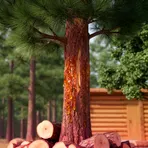
- In the harsh conditions of the eastern forest, the northern pitch pine flourishes with its thick bark and clusters of three needles.
Examples
-
The northern pitch pine thrives in poor, sandy soils where few other trees can survive.
-
The cones of the northern pitch pine require high heat to open and release their seeds.
-
Foresters conducted a survey of the local northern pitch pine population after the wildfire.
-
Look at that northern pitch pine!
-
The northern pitch pine is known for its tall stature.
-
The northern pitch pine grows tall and straight, making it an important species in eastern North American forests.
-
Ecologists studied the northern pitch pine to understand its resilience to drought compared to other tree species.
Synonyms


 1
5.8
1
5.8
A large pine tree from eastern North America that people use for its wood and sticky sap

A large pine tree with groups of three needles that grows in eastern North America
Surface Forms
Morphology
The phrase is directly compositional: 'pine' identifies the tree, 'northern' marks its geographic position, and 'pitch' (tar/resin) describes a characteristic of the tree, so a learner who knows those words can infer it is a type of resinous pine found in the north. This follows ordinary adjective + noun composition and is therefore immediately comprehensible to B1 learners who know the constituents.
Etymology
Northern pitch pine comes from the parts of its name: northern points to where it grows, pitch is the sticky resin the tree makes, and pine is the kind of tree. So the name means a pine from the north that makes a lot of pitch, which is why we use it for that tree today.