
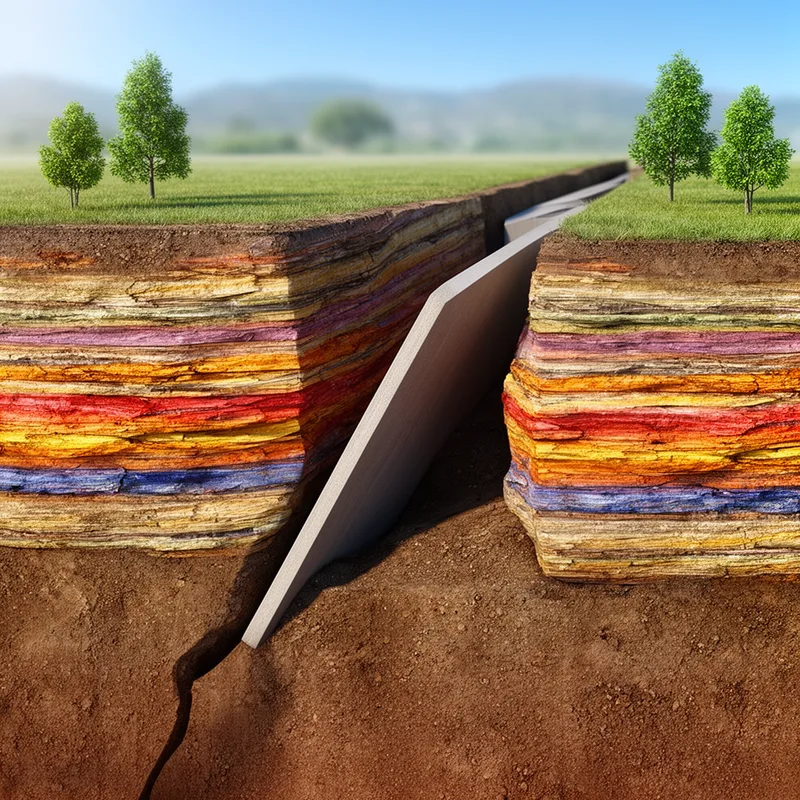
normal fault


 1
7.0
1
7.0
- noun
- /ˈnɔrməl fɔlt/
- Specialized
- The landscape features large cliffs created by the movement of a normal fault over millions of years.
Examples
-
A normal fault occurs when tectonic forces pull the earth's crust apart, causing one side to drop down.
-
Scientists study normal faults to understand how earthquakes are generated in the earth's crust.
-
Are there normal faults on the un-imaged hemisphere of Mercury that we don't see?
Academic text (2007)
Synonyms
 63
6.1
63
6.1
A crack in the earth's crust where the ground has moved
 1
5.0
1
5.0
A crack in the Earth's crust where rock layers move

A break in rock where the top part moves down past the lower part

A sloping break in rock where the upper block moves down because of its weight

A break in the ground where one side moves up at an angle
Surface Forms
Morphology
The noun 'fault' clearly signals a tectonic fracture, so a learner will likely infer this is a type of fault; however the adjective 'normal' here is a technical modifier (relating to orientation/tectonic regime) and does not transparently convey the specific sense that the hanging wall has moved downward. Understanding the full definition requires domain knowledge of geological movement, so the relation is partially clear but not fully predictable to a B1 learner.
Etymology
Normal fault is a name for a break in the Earth's rock where the top block moves down. The word fault means a break and normal was used because this 'drop down' is the usual motion when the ground is pulled apart, so the phrase means a break where the upper side has moved down.