
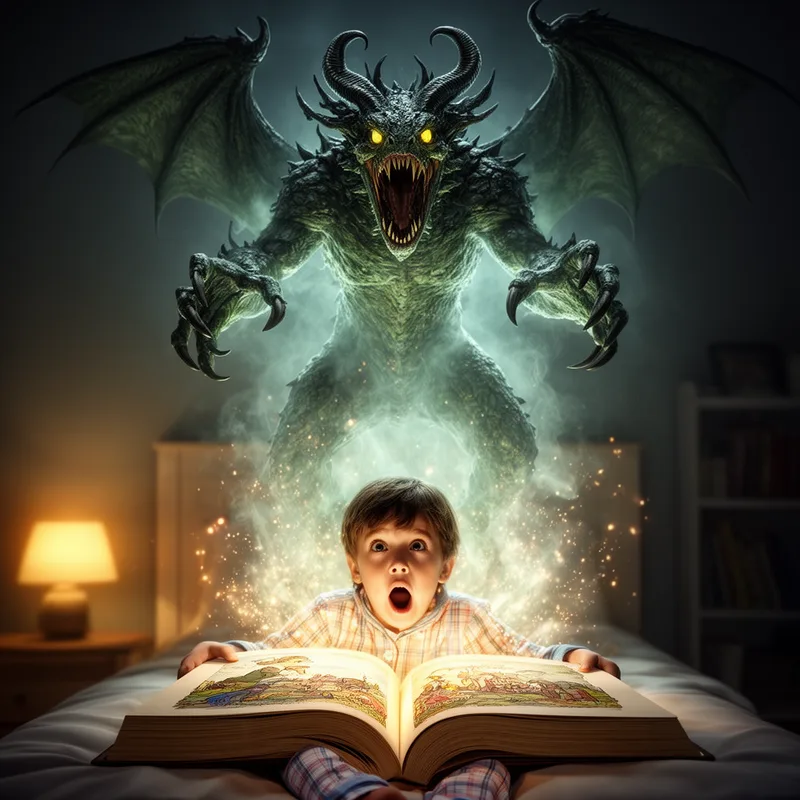
mythical monster


 1
8.1
1
8.1
- noun
- /ˈmɪθɪkəl ˈmɒnstər/
- The legend spoke of a mythical monster with the body of a lion and the wings of a dragon that lived high in the mountains.
Examples
-
Do you believe in a mythical monster like Bigfoot?
-
Many cultures have their own version of a mythical monster meant to frighten children into good behavior.
-
As a child, he was fascinated by stories of the mythical monster that haunted the nearby woods.
-
The film featured a terrifying mythical monster rising from the depths of the sea.
-
The mythical monster terrified the villagers.
-
In the village, stories of a mythical monster that guards the caves have terrified children for generations.
-
Many cultures feature tales of a mythical monster that embodies their greatest fears and challenges.
Synonyms
 ∞
2.2
∞
2.2
A large frightening imaginary creature often made of human and animal parts
 4
5.9
4
5.9
An imaginary being like a dragon or unicorn with magical powers
 1
6.5
1
6.5
A made-up creature from old stories or folk tales
 1
7.0
1
7.0
A made-up animal or being from old stories that people often say is real
A made-up being that exists only in stories or imagination

A creature that people imagine and that is not real
How Scary

Surface Forms
Morphology
The phrase is a straightforward adjective + noun composition: 'mythical' (existing in traditional stories) + 'monster' (an imaginary frightening creature) directly yields a creature from folklore. This follows common cross-linguistic patterns and would be immediately understandable to a B1 learner who knows both constituent words.
Etymology
Mythical monster comes from tales where mythical meant 'from old stories' and monster meant 'a big, scary creature'. So it now means 'a creature from old stories' that is 'frightening' and not real.