
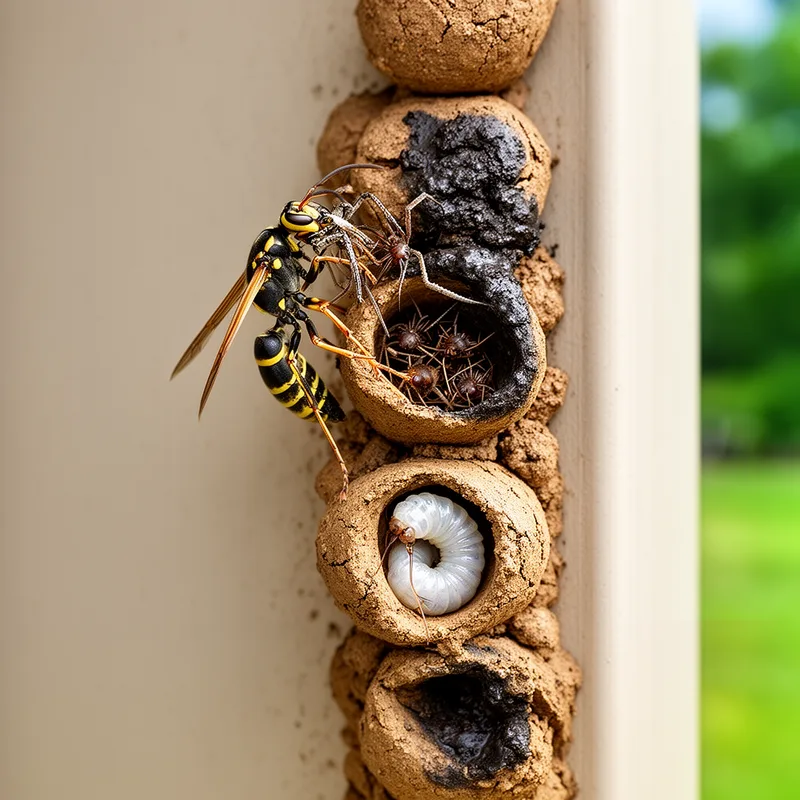
mud dauber
- noun
- /mʌd ˈdɔːbər/
- I watched a mud dauber expertly gather mud and fly back to its nest.
- mud dauber wasp
Examples
-
The mud dauber constructs its nests out of mud, often found under eaves or in sheds.
-
Swallows in there, and wasps and mud daubers, the furniture carrying a crust.
Fiction book (1995) -
Mud daubers lay their eggs in paralyzed insects, which serve as food for their larvae.
Synonyms

A wasp that builds small nests from mud

A wasp that lives alone and builds small mud nests for its young
A small wasp that builds a pot-shaped nest from mud

A wasp that lives alone and builds vase-shaped mud nests for its eggs
Surface Forms
Morphology
The compound combines 'mud' (sticky earth) with 'dauber' (one who daubs/apply something), so a B1 learner who knows both constituents can infer an agent that works with or applies mud — i.e., a creature that builds with mud. This compositional pattern (agent + material) is straightforward and cross-linguistically common, so the core meaning (a wasp that uses mud to make nests) is transparently derivable from the parts.
Etymology
Mud dauber comes from the wasp's habit of using mud to build small tube nests. A dauber is 'someone who smears', so the name literally means a wasp that smears mud to make its home, which is why we call that insect a mud dauber today.

