

to leaven the dough
- phrasal verb
- She forgot to leaven the dough, so her bread turned out dense and flat.
Loading YouTube…
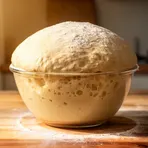
Watch on YouTubeAs the dough starts to leaven, what happens to the raisins within the dough?
- As the dough starts to leaven, what happens to the raisins within the dough?
Examples
-
Yeast is commonly used to leaven the dough in traditional bread recipes.
-
You need to leaven the dough properly for a good rise.
-
Before baking, it is important to leaven the dough to achieve a light texture.
-
Why didn't you leaven the dough before shaping it?
-
Before baking, it is important to leaven the dough with yeast so that it becomes fluffy and light.
-
Adding baking powder will help leaven the dough and make your biscuits rise perfectly.
-
To make a successful pizza crust, you must leaven the dough before spreading the sauce.
Synonyms
 8
4.8
8
4.8

To make dough become light and puff up before baking
 4
6.6
4
6.6
Make dough rise by adding yeast or baking powder

To add a very small living thing to dough or liquid so the mixture rises and ferments
Antonyms

How Light

Surface Forms
Morphology
The verb 'leaven' literally means to cause dough to become light, and when combined with 'dough' the phrase names that specific cooking action; the article 'the' does not affect compositional meaning. This is a straightforward verb + object construction common in recipe language and cross-linguistically parallel, so a learner who knows the constituent words will understand it.
Etymology
Leaven the dough comes from baking, where cooks add a small, living leaven like yeast to the dough. The yeast makes bubbles that lift the dough and make it 'light', so the phrase means 'to make the dough rise and become light'.