

laying waste
 14
8.8
14
8.8

- idiom
- In a fierce storm, the hurricane laid waste to the coastal areas, leaving destruction in its path.
Examples
-
25 years ago, Hurricane Andrew laid waste to this town, and now Tammy's here to do it all over again.
-
"I speak for those whose land is being laid waste, whose homes are being destroyed, whose culture is being subverted," he said.
Academic text (2005) -
"I am afraid that God has sent these men to lay waste the world."
Blog text (21) -
You will tell them that this earth will be laid waste.
-
You know, they laid waste to good parts of the Arctic.
-
And when that didn't work, she simply laid waste to everything and everybody in her way.
Fiction book (1999) -
Such thinking has laid waste to the Gaza Strip three times between 1989 and 2006.
Academic text (2007) -
An unfamiliar beach laid waste by monster waves under a storm sky.
Fiction book (1991) -
They sprang from the trees... and laid waste to forty of our most formidable men.
-
And it is written that in the year 63 B. C... ...the Roman legions, like a scourge of locusts... ...poured through the east... ...laying waste the land of Canaan and the kingdom of Judea.
Synonyms
 849
3.0
849
3.0
Severe damage that makes something no longer exist or cannot be fixed
 100
3.2
100
3.2
A state of complete destruction or loss
 72
4.2
72
4.2
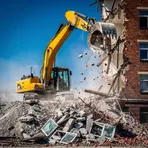
The act of destroying a building or other structure on purpose
 31
4.4
31
4.4
The act of tearing down a building to destroy it
 11
4.2
11
4.2
An act of completely taking down a building so it no longer exists
 6
7.6
6
7.6
A complete destruction or great loss that makes something worthless


 1
4.4
1
4.4
A complete tearing down of a building or other structure

A state of complete destruction that leaves a place ruined

Damage that destroys something or makes it unusable

The act of destroying something so it is completely ruined
Antonyms


How Destructive

Surface Forms
Morphology
laying + waste
The noun phrase 'laying waste' is directly built from the participle 'laying' (putting/causing) plus 'waste' (destruction), so its meaning 'causing extensive destruction' is compositionally inferable as 'putting into a state of waste'. The construction follows the common English pattern 'lay waste (to)' and has clear equivalents in many languages, so a B1 learner who knows the constituent words would very likely understand it.
Etymology
Laying waste comes from the image of an army or storm that would lay a place low and turn it into waste, leaving fields and buildings gone and the land empty. That's why it now means 'to cause great destruction'.