
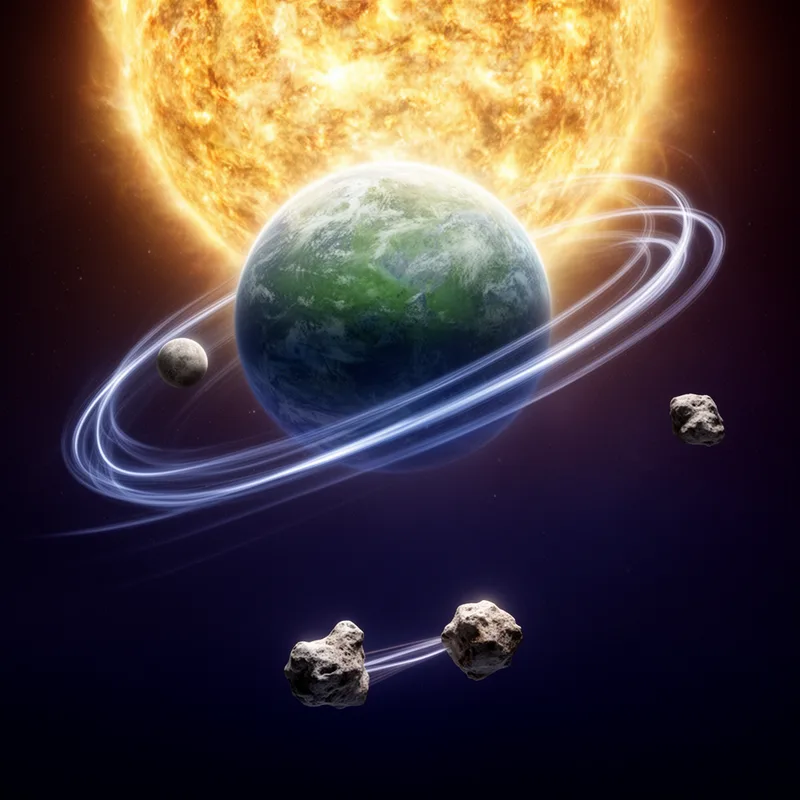
law of gravitation
- noun
- /lɔː əv ˌɡrævɪˈteɪʃən/
- Specialized
- OK, Newton's, Newton's universal law of gravitation was said to stipulate that there was an action at a distance from from one mass to another.
- the universal law of gravitation
Examples
-
So not only did he formulate laws of gravitation, he also invented calculus.
-
"The law of love will work, just as the law of gravitation will work, whether we accept it or not...." --
Blog text (11) -
His universal law of gravitation is somewhat more complicated.
Academic text (2004) -
And so, yeah, it's it's possible to question whether the universal law of gravitation applies to particles.
-
It is subject to some, to some laws of nature, law of gravitation that govern what happens to me.
-
In fact, as I'm sure you know, the laws of gravitation don't naturally lend themselves to a extension in the special theory of relativity.
-
Of far more importance than Newton's contribution to the calculation of pi are his three universal laws of motion and his single universal law of gravitation.
Academic text (2004) -
Newton's law of gravitation explains how two objects attract each other based on their masses.
-
Scientists use Newton's law of gravitation to calculate the gravitational force between planets.
-
The law of gravitation describes why apples fall from trees towards the ground.
Synonyms

 4
3.7
4
3.7

An idea that all objects pull on each other, more when they are heavier and closer

A law saying every two objects pull each other with force that grows with mass and decreases with distance
Surface Forms
Morphology
law + of + gravitation
The phrase denotes the scientific rule governing gravitation and is directly compositional from 'law' (a general scientific principle) combined with 'gravitation' (the force causing masses to attract). The linking preposition 'of' is transparent, and this construction is cross-linguistically common, so a B1 learner who knows the constituent words would readily infer the meaning.
Etymology
Law of gravitation comes from Isaac Newton's famous story about an apple falling. He saw the apple fall and realised the same invisible gravitation 'pull' that makes apples fall to Earth also keeps the moon moving, so he described a rule saying every object 'pulls' on every other object. That's why the phrase means that any two objects 'attract' each other.