
koan
 4
9.9

- noun
- /koʊˈɑn/
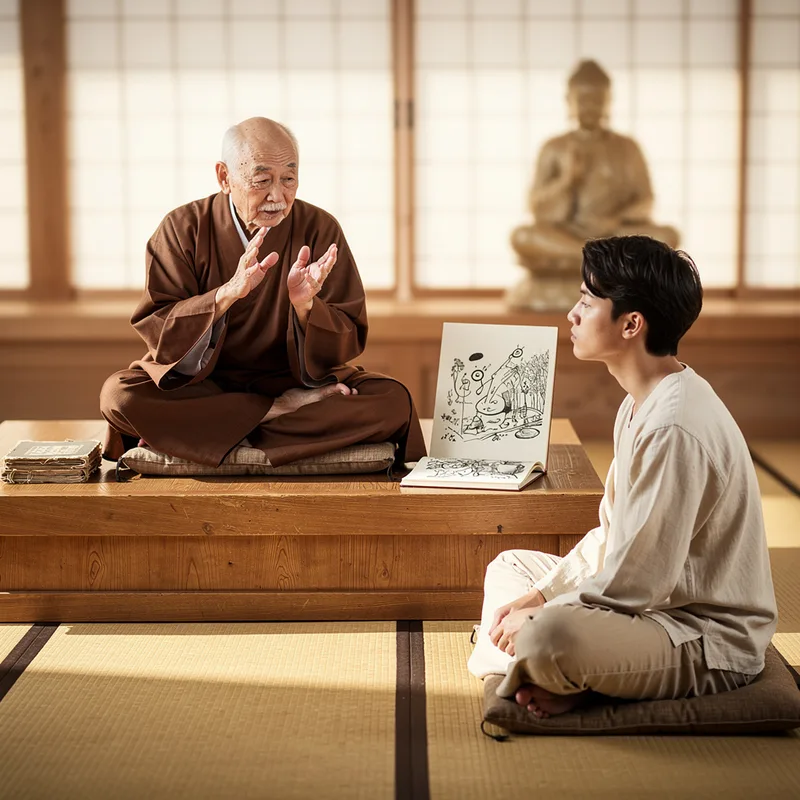
- Alternatively, a master might deliver the koan to a student by holding up a staff and saying, "This is not a staff."
- Zen koan
- koan practice
- working on a koan
Loading YouTube…
Watch on YouTubeRecall the old monks koan the correct reply to Master Baijong's question.
- Recall the old monks koan the correct reply to Master Baijong's question.
- Now I'm learning about all these koans that are kind of interweaving and, and, and, and I'm starting to use these koans in my life.
- And then he starts giving some, you know what it would turn out to be Koans.
Examples
-
The koan method of inquiry began in China in the twelfth century with the Sung masters.
Academic text (1994) -
I unrolled it, expecting to see words—maybe a hand-set poem or a Zen koan done in calligraphy.
Fiction book (2000) -
The koan is a kind of puzzle or problem given to a student by a master.
Academic text (1994) -
I am reminded of a Zen koan still used in the training of monks.
Academic text (1994) -
The koan takes on the dimensions of a life-and-death struggle for the ego.
Academic text (1994) -
You're supposed to contemplate the koan until you achieve a greater awareness.
Fiction book (1995) -
A "koan" is a fundamental part of the history and lore of Zen Buddhism.
Academic text (2015) -
The initial objective of the koan is to propel the student into an experience called the "great doubt (daigi)."
Academic text (1994) -
Thus, while mainstream Rinzai Zen practitioners rely on koans to achieve satori, some Zen masters criticized their use.
Academic text (1994) -
During meditation, he pondered a Zen koan that challenged his understanding of reality.
Synonyms
 102
7.1
A situation or statement that seems both true and false at the same time
How Puzzling

Surface Forms
Etymology
Koan comes from a Japanese word kōan meaning 'public case', because Zen teachers used short cases or questions in public teaching. That's why a koan today is a puzzling question or story that stops ordinary thinking and helps you reach new understanding.