
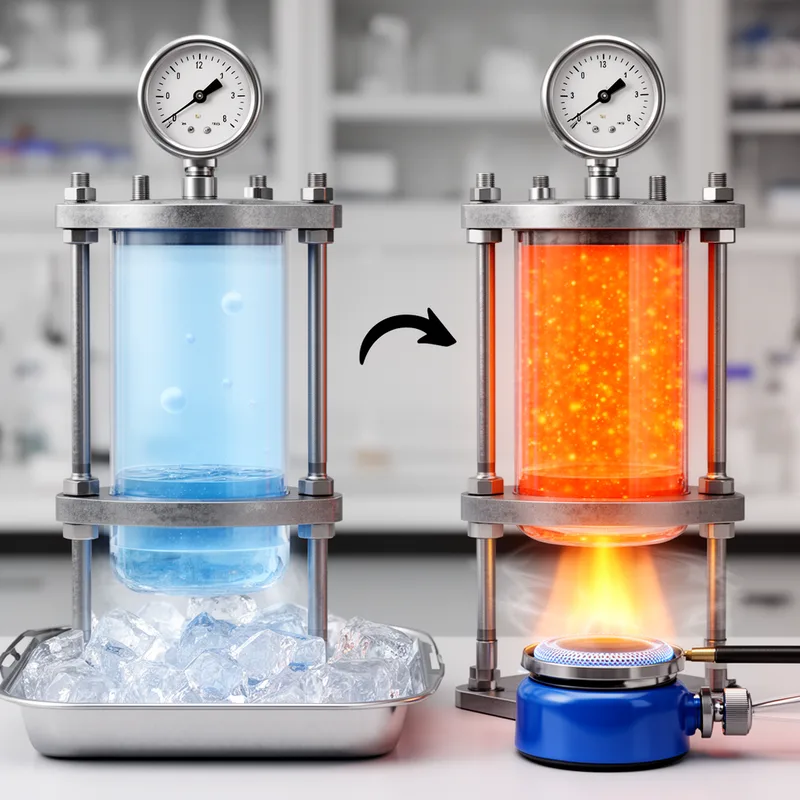
isochoric process
- noun
- /ˌaɪsəˈkɔrɪk ˈprɑsɛs/
- Specialized
- In an isochoric process, the volume of the gas does not change while heat is added or removed.
Examples
-
An isochoric process occurs when a gas is heated in a sealed container.
-
Cooling a gas at constant volume is an example of an isochoric process.
-
The pressure inside the vessel increased during the isochoric process.
-
The isochoric process is crucial in understanding thermodynamics.
-
Cooling a gas at constant volume is an example of an isochoric process.
-
In an isochoric process, the volume of the gas does not change while heat is added or removed.
-
An isochoric process occurs when a gas is heated in a sealed container.
Synonyms

A process in which the space a gas takes stays the same while pressure or temperature change

A process where a sealed container keeps the same volume while pressure or temperature change

A process where the volume stays the same while pressure or temperature change
Surface Forms
Morphology
isochoric + process
The noun 'process' simply combines with an adjective in a fully compositional way, but the crucial element is 'isochoric', a technical adjective built from Greek roots (iso- 'equal/constant' + -choric relating to space/volume) that is not transparent to a B1 learner. Because understanding the phrase depends on specialist morphological knowledge or prior exposure to the adjective rather than everyday vocabulary, the expression is only partially predictable for typical learners.
Etymology
Isochoric process comes from the parts iso- (meaning 'equal') and choric (from a word for 'space' or 'room'), so it literally suggests 'equal space'. That's why an isochoric process means a process where the system's volume stays the same and does not change.

