
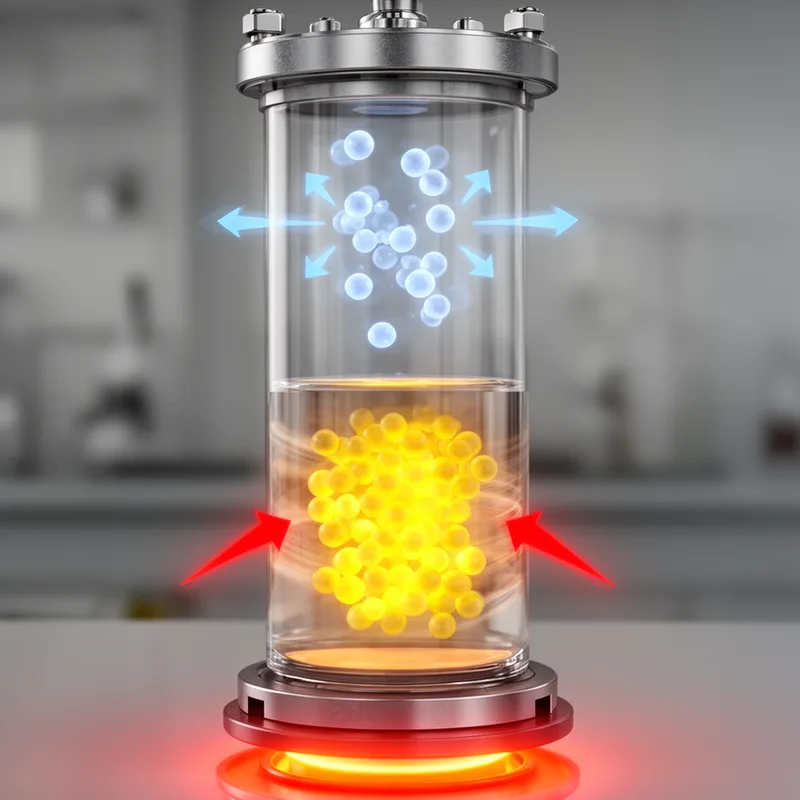
isovolumetric process
- noun
- /ˌaɪsoʊˈvɑːljʊˌmɛtrɪk ˈprɒsɛs/
- Specialized
- Heating a gas in a sealed rigid container is an example of an isovolumetric process.
Examples
-
In an isovolumetric process, any change in temperature leads to a corresponding change in pressure without altering the volume.
-
During an isovolumetric process, the pressure of the gas may change, but its volume remains fixed.
-
The concept of an isovolumetric process is fundamental in understanding how engines operate under constant volume conditions.
-
An isovolumetric process occurs when a gas is heated in a closed container.
-
During an isovolumetric process, the volume does not change.
-
During an isovolumetric process, the pressure of a gas increases while its volume remains unchanged.
-
Heating a gas in a sealed rigid container is an example of an isovolumetric process where the volume does not vary.
Synonyms

A change in a system where the volume stays the same

A process where the volume stays the same while pressure or temperature change

A process in which the space a gas takes stays the same while pressure or temperature change
Surface Forms
Morphology
isovolumetric + process
The noun 'process' is transparent but the key constituent 'isovolumetric' is a specialised, morphologically complex scientific adjective (iso- + volumetric) that many B1 learners will not recognise; however, learners who know the root 'volume' or the iso- prefix can infer ‘constant/unchanging volume’. Because comprehension depends on morphological and domain knowledge rather than simple compositional meaning, the expression is only partially predictable for an average B1 learner.
Etymology
Isovolumetric process comes from parts that tell you the volume does not change. The part iso- means 'equal' and volumetric is about the 'volume' or space inside a closed container, so the phrase describes a process where the container's volume 'stays the same' while pressure or temperature can change.

