
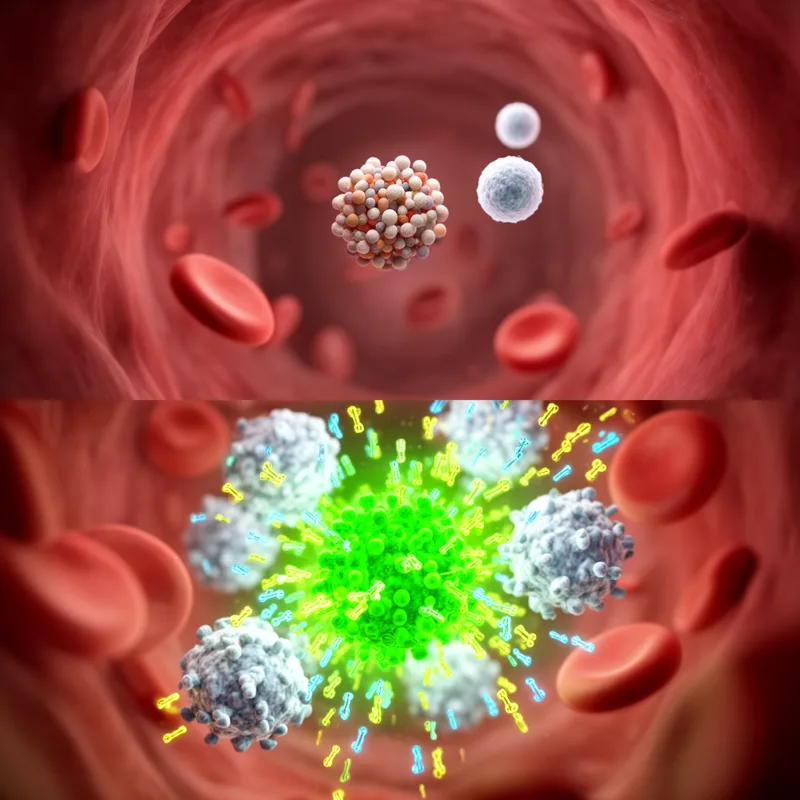
immunogenicity
 1
8.9
1
8.9

- noun
- /ˌɪmjunəˌdʒɛnɪˈsɪti/
- Specialized
- The researchers measured the immunogenicity of the new vaccine in healthy volunteers.
- immunogenicity of these vaccines
- immunogenicity and safety
- difference in immunogenicity
Examples
-
The lack of activity of this vaccine could be due to its low immunogenicity in HIV-1-infected individuals.
Academic text (1996) -
A key issue in the development of any therapeutic protein is to minimize immunogenicity to avoid adverse effects.
Academic text (2017) -
A schedule of frequent immunization was chosen for maximum immunogenicity.
Academic text (1996) -
Given these data, one cannot conclude that ACE always increases the immunogenicity of a particular peptide.
Academic text (2018) -
Finally, the types and doses of immunosuppressive agents administered may have an effect on vaccine immunogenicity.
Academic text (2017) -
Several previous studies of candidate vaccines have shown short-term safety and immunogenicity in HIV-infected individuals.
Academic text (1996) -
We found a correlation between MTBC strains of higher immunogenicity and their ability to spread within the human host population.
Academic text (2013) -
Unfortunately, there are no published studies on the tolerability and immunogenicity of inactivated typhoid vaccines in transplant recipients.
Academic text (2017) -
Thus, the conformation conferred by other residues within or outside the P4 pocket is likely to contribute to the immunogenicity of DRB1*0402.
Academic text (2007) -
Despite a randomized trial demonstrating no significant difference in immunogenicity in renal transplantation candidates and recipients who received PPSV-23 versus PCV-7, current guidelines recommend both vaccines.
Academic text (2017)
Synonyms


 1
8.2
1
8.2
How much the immune system reacts to a substance in lab tests

Ability of a substance to make the immune system react
How Immunogenic
- Specialized
1
8.9

- Specialized
Surface Forms
Morphology
immunogenicity = immunogenic (semi-transparent) = immuno + gen + ic + ity
The noun is formed regularly from the adjective immunogenic by adding the suffix -ity.
Etymology
Immunogenicity is made of immune, meaning the body's defence or 'protected', plus genic, a root that means 'to produce' like in generate, and -ity, which means 'the quality of'. So immunogenicity is the 'quality of producing' an 'immune response', or simply how likely something is to make the body's defence react.