

immunoreactivity


 1
8.2
1
8.2
- noun
- /ˌɪmjunəʊrɪˈæktɪvɪti/
- Specialized
- For claudin-1, the intensity of staining was also graded as weak, moderate, or strong, with immunoreactivity of perineurial cells in normal peripheral nerve tissue as a reference for strong staining.
- immunoreactivity for claudin-1
- immunoreactivity for bcl-2
- p53 immunoreactivity
Examples
-
The immunoreactivity was quantified as percent area covered by the staining, using Metamorph software (Molecular Devices, Version 7.6).
Academic text (2018) -
The immunoreactivity in the samples indicated a strong immune response to the markers used in the tests.
-
In contrast, no immunoreactivity for claudin-1 was seen in any of the other tumor types.
Academic text (2007) -
Seven of the 15 BSCC specimens exhibited no immunoreactivity with bcl-2.
Academic text (2008) -
In the control group, cytoplasmic immunoreactivity for bcl-2 was seen in 7 of the 15 specimens (46.7%) (Table 2).
Academic text (2008) -
In our patient, the immunohistochemical study with antimitochondrial antibody revealed intense immunoreactivity of the cytoplasm in the tumor cells.
Academic text (2003) -
Immunohistochemical staining for synaptophysin, neurofilaments, and S-100 protein demonstrated a normal pattern of immunoreactivity.
Academic text (2010) -
Immunoreactivity for claudin-1 was significantly more frequent in meningiomas than in the other neoplasms examined (P < 0.05).
Academic text (2007) -
Finally, enhanced chemiluminescence (Supersignal, West Pico Chemiluminescent substrate; Pierce, IL, USA) was used for the detection of immunoreactivity on exposure to X-ray films.
Academic text (2018) -
In our patient, the immunohistochemical study revealed intense immunoreactivity of the cytoplasm in the tumor cells.
Synonyms
 1
8.9
1
8.9
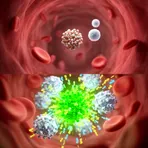
How well a substance makes the body's immune system react

Ability of a substance to make the immune system react
How Immunoreactive
- Specialized

- Specialized
1
8.2
- Specialized
- Specialized
Surface Forms
Morphology
immunoreactivity = immunoreactive (semi-transparent) = immuno + react + ive + ity
Regular noun formation from the adjective 'immunoreactive' using the productive suffix '-ity'.
Etymology
Immunoreactivity comes from two parts, immune, about the body's defense and 'protected', and reactivity, from react meaning 'to respond'. So, immunoreactivity describes how strongly the immune system responds to a substance.