

hog-nosed skunk
- noun
- /hɔg-noʊzd skʌŋk/
- Specialized
- The hog-nosed skunk used its snout to root around for insects near the desert brush.
Examples
-
Researchers tracked the movements of a family of hog-nosed skunks across the Mexican plains.
-
I spotted a hog-nosed skunk with a bushy white tail in the twilight.
-
The hog-nosed skunk is known for its unique appearance.
-
Have you ever seen a hog-nosed skunk in the wild?
-
I spotted a hog-nosed skunk with a bushy white tail in the twilight.
-
Researchers tracked the movements of a family of hog-nosed skunks across the Mexican plains.
-
The hog-nosed skunk used its snout to root around for insects near the desert brush.
Synonyms

A large skunk with a long nose and white back and tail from southwestern North America and Mexico

A large skunk with a bare pig-like nose and a white back and tail from southwestern North America
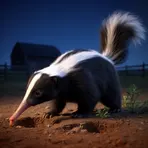
A large skunk with a long nose and a white stripe on its back and tail
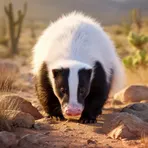
A large skunk with a bare nose and white back and tail found in southwestern North America and Mexico
Surface Forms
Morphology
hog-nosed + skunk
The compound is compositionally transparent: 'hog-nosed' clearly means 'having a pig-like (hog) nose' and 'skunk' names the animal, so the overall meaning (a skunk with a hog-like snout) can be derived from the parts. Even if 'hog-nosed' isn't listed, the adjective-forming pattern (X-nosed = having an X-like nose) is regular and cross-linguistically intuitive, so a B1 learner who knows 'hog', 'nose', and 'skunk' will likely infer the meaning.
Etymology
The name hog-nosed skunk comes from its bare, pig-like nose that it uses to dig in the ground for insects. So the name means a skunk with a 'hog'-like 'nose', and that clear picture helps you remember the animal.

