
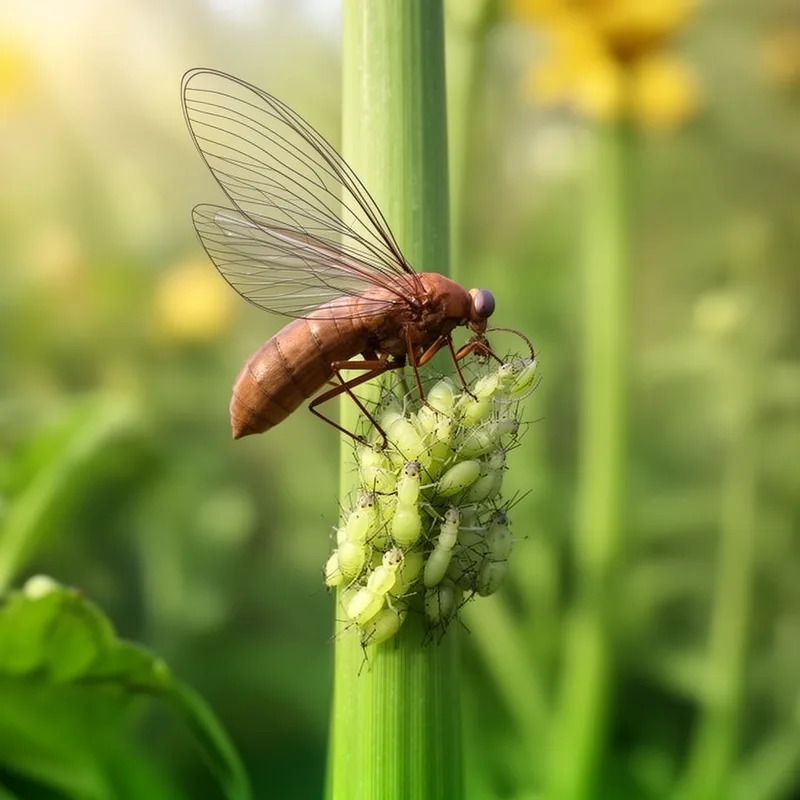
hemerobiid fly
- noun
- /ˌhɛmərəˈbiːɪd flaɪ/
- Specialized
- The hemerobiid fly is often found in gardens where it preys on aphids.
Examples
-
A hemerobiid fly can be recognized by its brown, delicate wings and soft body.
-
Scientists study the hemerobiid fly for its beneficial role in controlling pest insects.
-
The hemerobiid fly is often found in gardens.
-
Many hemerobiid flies help control pest populations.
-
The hemerobiid fly is often admired for its delicate wings that shimmer in the sunlight.
-
Scientists study the hemerobiid fly because it plays a crucial role in keeping aphid populations in check.
-
In many gardens, the presence of a hemerobiid fly indicates a healthy ecosystem that thrives on natural pest control.
Synonyms
 1
8.9
1
8.9

A small insect with thin, net-like wings whose young eat aphids and other garden pests
A small insect with thin wings whose young eat plant pests like aphids

A small brown insect with thin wings whose larvae eat aphids
A small delicate insect with thin net-like wings whose young eat garden pests like aphids
How Big

Surface Forms
Morphology
This is a straightforward modifier + noun compound: if a learner knows 'hemerobiid' (a type of lacewing) and 'fly', they can infer the phrase means a fly belonging to the Hemerobiidae group. The meaning is fully compositional and non-idiomatic, so it is immediately derivable from its parts.
Etymology
Hemerobiid fly comes from old Greek parts hemero meaning 'day' and bios meaning 'life', a phrase used for insects thought to live only a short time. These small, brown lacewing flies are delicate and their young eat pest insects, so the name helps you remember a tiny, short-lived fly that helps control garden pests.