

lacewing
 1
8.9
1
8.9

- noun
- /ˈleɪsˌwɪŋ/
- A garden with lacewings is healthier, as these insects naturally reduce the number of insect pests.
- lacewing larva
- Green lacewing
Examples
-
Green lacewings are important for gardens because they feed on harmful pests like aphids.
-
For example, a lacewing that is mass-marketed requires a diet of insect eggs.
Academic text (1997) -
This vigorous lacewing is a 14th-generation progeny reared on the new diet.
Academic text (1997) -
Williams and others at Stoneville have identified several plant bug predators, including minute pirate bugs, green lacewings, and big-eyed bugs.
Academic text (1999) -
Gerald grasped the bottle of gin and sat back as the narrator continued, speaking now of aphid-farming ants and the lacewing larva.
Fiction book (1998) -
Recently, the debate in Europe has focused on indirect harm to carnivorous insects higher in the food chain, such as the lacewing, a beneficial predator commonly found in maize fields.
Academic text (1999) -
With this diet, scientists can now mass-rear big-eyed bugs, Geocoris punctipes, and lacewings, Chrysoperla carnea.
Academic text (1997) -
Using video microscopy, entomologist Allen Cohen observes details of a green lacewing larva feeding on a cabbage looper larva.
Academic text (1997) -
You can often find lacewings fluttering around flowers, where they help control pest populations.
Synonyms
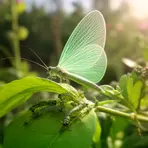
A small delicate insect with thin net-like wings whose young eat garden pests like aphids
Compounds

A small delicate insect with thin net-like wings whose young eat garden pests like aphids

- Specialized
A small pale green insect with delicate lace-like wings that eats garden pests
How Long-Necked

Surface Forms
Morphology
Etymology
The word lacewing comes from the English words lace and wing because this insect has thin, net-like wings that look like 'lace'. So, the name helps you remember it is a small, delicate insect gardeners value because it eats garden pests.