

green lacewing
- noun
- /ɡrin ˈleɪsˌwɪŋ/
- Specialized
- Using video microscopy, entomologist Allen Cohen observes details of a green lacewing larva feeding on a cabbage looper larva.
- green lacewing larva
Examples
-
Green lacewing larva attacks a cabbage looper larva. Magnified about 15x.
Academic text (1997) -
In my view, green lacewings should be near the top of any gardener's list of favorite beneficial insects.
-
When you see green lacewings in your garden, don't kill them.
-
Using video microscopy, entomologist Allen Cohen observes details of a green lacewing larva feeding on a cabbage looper larva.
Synonyms
 1
8.9
1
8.9

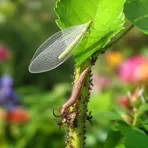
A small insect with thin, net-like wings whose young eat aphids and other garden pests

A small pale green insect whose young eat garden pests and that smells unpleasant

A pale green fly that gives off a bad smell and whose young eat insects that harm plants

A small green insect with thin wings and shiny gold eyes that eats garden pests
Surface Forms
Morphology
The meaning 'a pale green insect with delicate, lace-like wings' is directly and predictably derived from combining 'green' (a colour) with 'lacewing' (a type of insect); it denotes a lacewing that is green. This simple adjective + noun compound follows common compounding patterns cross-linguistically and would be understandable to a B1 learner who knows both constituents.
Etymology
The name green lacewing comes from how the insect looks: green for its pale color and lacewing for its thin, delicate wings that look like lace. So the name points to a small green insect with lace-like wings that gardeners often use to control pests.