
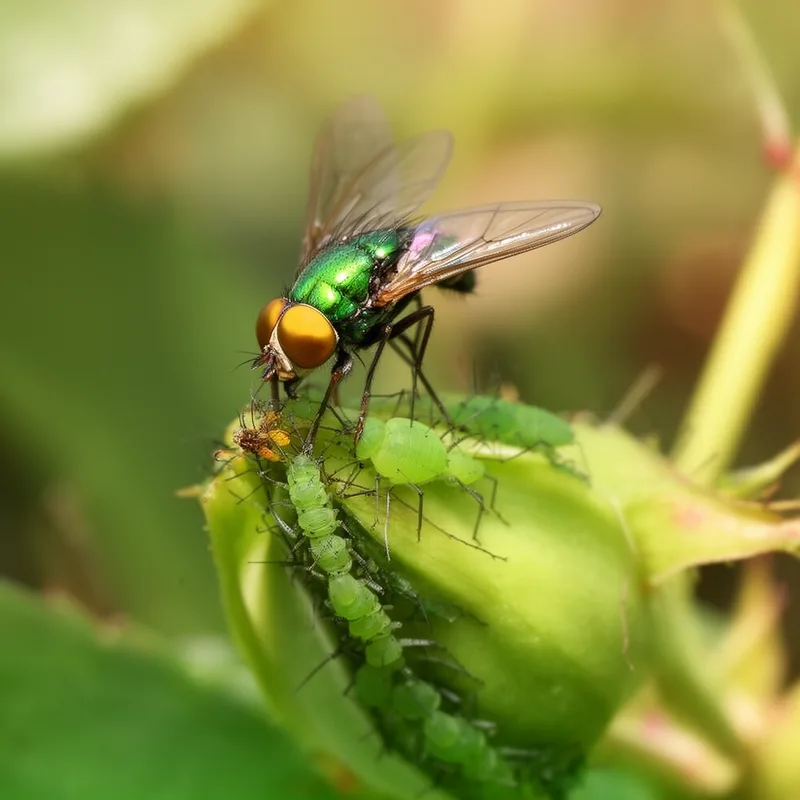
golden-eyed fly
- noun
- A golden-eyed fly hovered over the rose petals, searching for aphids.
Examples
-
Many gardeners attract golden-eyed flies to help reduce harmful insect populations.
-
The golden-eyed fly is often used in gardens as a natural pest control agent.
-
The golden-eyed fly landed on the flower.
-
Have you ever seen a golden-eyed fly before?
-
A golden-eyed fly floated gracefully in the sunshine, its delicate wings glimmering.
-
Gardeners often release golden-eyed flies in their gardens to keep aphid populations low.
-
The golden-eyed fly flitted from flower to flower, a natural beauty in the garden.
Synonyms
 1
9.9
1
9.9

A small green insect with thin wings and golden eyes that eats plant pests

A small pale green insect with delicate lace-like wings that eats garden pests
A small delicate insect with thin net-like wings whose young eat garden pests like aphids
Surface Forms
Morphology
golden-eyed + fly
This is a straightforward compositional noun phrase: 'golden-eyed' describes having golden (gold-coloured) eyes and 'fly' names an insect, so the meaning 'a fly with golden eyes' is directly derivable from the parts. Descriptive adjective+noun compounds like this are cross-linguistically common and follow standard composition, so a B1 learner who knows the constituents will understand it.
Etymology
Golden-eyed fly is named for the small green lacewing's shiny golden eyes and thin, see-through wings that catch the light. Because these bugs eat aphids and other pests, the name now brings to mind a useful garden helper or 'natural pest control'.