

hard clam
- noun
- /hɑrd klæm/
- US
- Indigenous peoples historically used hard clams as a form of currency in trade.
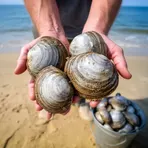
- gathering hard clams
- bushels of hard clams
- hard clams from the bay
Examples
-
In addition, colonists ate hard clams, soft clams, and lobsters, which were often pickled in vinegar.
Academic text (1990) -
Some hard clams were gathered with tongs and short-handle rakes, and in summer, by barefoot treaders.
Academic text (1990) -
In their festivals, hard clams were the featured food.
Academic text (1990) -
From 15 to 20 fishermen dug hard clams daily for each plant.
Academic text (1990) -
Along the offshore edges of the flats, fishermen got some hard clams also.
Academic text (1990) -
Sail dredging for hard clams is believed to have been unique to Raritan Bay.
Academic text (1990) -
In 1989, they dug 55,639 bushels of hard clams in Raritan Bay.
Academic text (1990) -
Boats with rocking-chair dredges could gather as many as 60 bushels of hard clams a day.
Academic text (1990) -
Oysters, hard clams, and soft clams were staple foods of Indians also (Smith, 1890; Kalm, 1937).
Academic text (1990) -
On the Atlantic coast, many restaurants serve delicious dishes made with hard clams.
Synonyms
 1
9.9
1
9.9

A large round clam with a hard shell that people eat on the east coast of North America

A large edible clam with a hard shell that was used as money by some Native American tribes
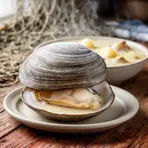
A large edible American clam with a heavy rounded shell often used in chowder
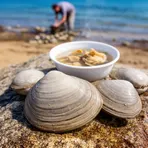
A North American clam with a thick hard shell that is eaten as food
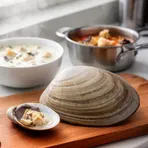
A large clam you can eat with a hard rounded shell
Surface Forms
Morphology
The phrase is a simple adjective+noun composition: 'hard' (firm) modifies 'clam' (bivalve), so a learner who knows both words can infer it refers to a clam with a hard/firm shell or body. While the entry notes a cultural use (shells used as money), that specific cultural information is additional; the core referent is fully compositional and predictable.
Etymology
The noun hard clam comes from its heavy, solid shell: hard describes the tough shell and clam is the sea animal. Long ago, people sometimes used these shells as a kind of 'money', so the name helps you remember it is a big, firm clam eaten and used for trade.