

hard-shelled


 1
3.6
1
3.6
- adjective
- /hɑrd-ʃɛld/
 :
de concha dura
:
de concha dura
- Many species of crab are known for their hard-shelled bodies, making them difficult to open.
A a, a crustacean animal like a crab cannot grow inside a hard shell.
- A a, a crustacean animal like a crab cannot grow inside a hard shell.
- A crustacean animal like a crab cannot grow encased in the hard shell.
- But underneath that hard shell is an extremely soft centre that has no resilience whatsoever.
Examples
-
Those features indicate that A. boisei was adapted to a diet of either tough and fibrous or hard-shelled foods.
Academic text (2003) -
Small kernels, each with a hard shell called a pericarp, and some varieties had a fantastic feature.
-
These first complex, hard-shelled creatures show a greater diversity of phyla than has ever existed before or since.
Academic text (1999) -
Bunches of things like kelp, lots of fish, and hard-shelled little creatures.
Fiction book (1998) -
That ticklish scuttling in her hair? A hard-shelled beetle falls to the ground.
Fiction book (1993) -
Other developments included hard-shelled eggs and seeds, reptile evolution, and the great Permian Period extinction.
Academic text (1995) -
Early on, we were most interested in the chimps' use of natural hammers—branches and stones—to crack open the five species of hard-shelled nuts that are abundant here.
Academic text (1991) -
The turtle has a hard-shelled exterior that protects it from predators.
-
Some fruits, like walnuts, are hard-shelled, requiring tools to crack them open.
Synonyms
 1
1.9
1
1.9
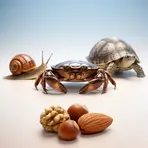
Having a hard outer covering like a crab or nut

Having a hard outer surface that protects what is inside

Having a hard shell or outer covering like a turtle

Has a hard outer skin that does not break easily
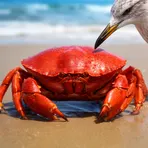
Having a hard outer shell like a crab or lobster
How Hard-Shelled
1
3.6

Surface Forms
Morphology
Etymology
The word hard-shelled is made from two plain parts, hard ('firm') and shell ('outer cover like a nut or egg'). So it pictures something with a firm outside that protects the inside, which is why we use it for animals or plants that have a hard outer shell.