

green foxtail
- noun
- /ɡrin ˈfɑkˌsteɪl/
- Specialized
- You can identify green foxtail by its characteristic foxtail-like flower heads and green bristly appearance.
Examples
-
Green foxtail often invades cornfields and competes with crops for nutrients.
-
The rapid growth of green foxtail makes it a persistent weed in gardens across the Midwest.
-
Farmers frequently battle green foxtail because it spreads quickly in disturbed soils.
-
The green foxtail is often found in disturbed areas.
-
Farmers consider green foxtails a nuisance in their fields.
-
Green foxtail can quickly overtake crops, reducing agricultural yields significantly.
-
Many gardeners struggle to control green foxtail due to its rapid reproduction in disturbed soil.
Synonyms

A common wild grass often found as a weed in crop fields
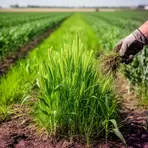
A fast growing grass that spreads quickly and harms crops
Surface Forms
Morphology
The phrase is a literal adjective+noun combination: 'green' (color) modifying 'foxtail' (a type of grass), so the meaning—a foxtail grass that is green—is directly compositional from the constituents. It is a descriptive botanical name rather than an idiom or metaphor, following common adjective+noun patterns and thus should be immediately understandable to a learner who knows both words.
Etymology
Green foxtail gets its name from the plant's look: the long, bushy, green flower heads look like a small fox's tail. Because those bristly 'tails' appear on many stems and the grass spreads fast in fields, people call this common 'weed' green foxtail, which is why the name means that particular grassy plant today.

