

glossopharyngeal nerve
- noun
- /ˌɡlɑːsəʊfəˈrɪndʒiəl nɜrv/
- Specialized
- Damage to the glossopharyngeal nerve can lead to difficulty swallowing and loss of the gag reflex.
Examples
-
Figure 2. Axial T2-weighted MRI reveals the vascular loop of the PICA (black arrow) compressing the glossopharyngeal nerve.
Academic text (2010) -
From there, it passes posterior to the glossopharyngeal nerve and lateral to the thyroid, and then into the mediastinum.
Academic text (2010) -
The glossopharyngeal nerve carries signals from the back of the tongue, helping to sense taste.
-
The doctor explained that the glossopharyngeal nerve plays a critical role in throat functionality.
Synonyms
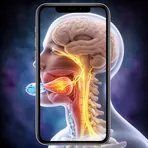
A brain nerve that helps you swallow, taste the back of the tongue, and move throat muscles

A nerve that sends feeling and taste from the throat and back of the tongue and helps swallowing
Surface Forms
Morphology
The compound is compositionally built from 'glossopharyngeal' (relating to tongue and pharynx) + 'nerve' (bundle of nerve fibers), so a learner who knows both constituents can infer it denotes a nerve serving the tongue/pharynx. Although technical, the structure is regular (adjective + noun) and the meaning follows directly from the parts, making it transparently derivable.
Etymology
Glossopharyngeal nerve comes from Greek parts: glosso ('tongue') and pharyngeal ('throat'), plus the word 'nerve'. So the name gives a clear picture: it is the nerve for the back of the 'tongue' and the 'throat', which is why it helps with taste and swallowing.

