

ninth cranial nerve
- noun
- /naɪnθ ˈkreɪniəl nɜrv/
- Specialized
- The ninth cranial nerve plays a crucial role in swallowing and taste sensation.
Examples
-
Damage to the ninth cranial nerve can result in difficulty eating and speaking.
-
Medical students must learn the function of the ninth cranial nerve during their anatomy courses.
-
The ninth cranial nerve plays a crucial role in swallowing.
-
She studied the ninth cranial nerve in her anatomy class.
-
Damage to the ninth cranial nerve can result in difficulty eating and speaking.
-
Medical students must learn the function of the ninth cranial nerve during their anatomy courses.
-
The ninth cranial nerve plays a crucial role in swallowing and taste sensation.
Synonyms
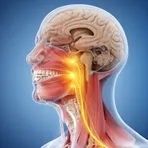
A nerve sending feeling from the throat and back of the tongue and helping control swallowing and the voice box

A nerve that sends feeling and taste from the throat and back of the tongue and helps swallowing
Surface Forms
Morphology
The compound is compositionally built from 'ninth' (ordinal), 'cranial' (relating to the skull/brain), and 'nerve' (bundle of nerve fibers), so a learner who knows these words will understand it refers to the ninth nerve associated with the skull/brain. While the detailed functional description (sensory/motor/parasympathetic roles) is specialist knowledge, the basic referent (the ninth cranial nerve as the ninth nerve in the cranial series) is directly derivable and cross-linguistically transparent.
Etymology
Ninth cranial nerve is a name from anatomy: it is the ninth of the nerves that start in the cranium, so cranial points to the 'skull' and nerve means a bundle that sends signals. This nerve goes to the back of the tongue and throat, so the ninth cranial nerve helps with taste and swallowing.

