
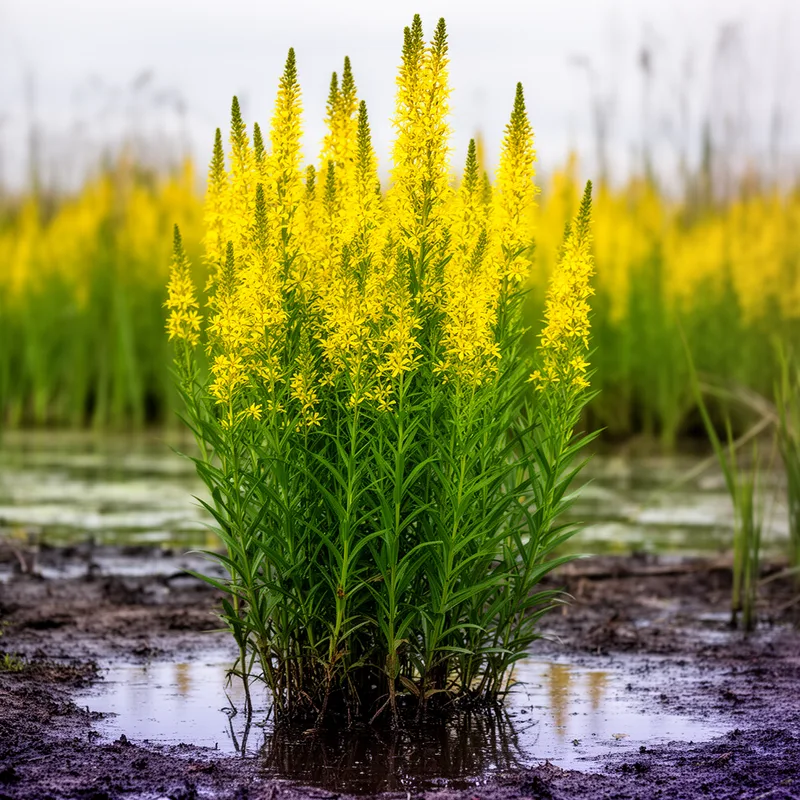
garden loosestrife
- noun
- /ˈɡɑrdən ˈlusˌtraɪf/
- UK
- The garden loosestrife quickly spreads and can take over wetland habitats if not managed.
Examples
-
Although garden loosestrife is attractive, it is often seen as invasive outside its native range.
-
Many gardeners mistake garden loosestrife for other types of loosestrife due to its similar yellow flowers.
-
The garden loosestrife blooms brightly in the summer.
-
Many gardeners dislike garden loosestrife due to its invasive nature.
-
The garden loosestrife can quickly dominate a garden, making it difficult for other plants to thrive.
-
Despite its beautiful yellow flowers, the garden loosestrife is often regarded as a troublesome weed.
-
In wetland areas, the presence of garden loosestrife can disrupt the local ecosystem.
Synonyms

A perennial plant with yellow flowers that grows in damp places and spreads quickly

A plant with bright yellow flowers that spreads quickly and often grows near water
How Invasive
- Specialized
 7
4.4
7
4.4

 187
1.0
187
1.0
- UK
- US

 1
5.1
1
1.0
1
4.8
1
5.1
1
1.0
1
4.8
Surface Forms
Morphology
This is a straightforward noun–noun compound: 'garden' modifies 'loosestrife' to indicate a loosestrife associated with gardens, so the phrase denotes a type of plant. Such subtype formation is a regular, compositional pattern (common cross-linguistically), so a learner who knows the constituent words can infer the meaning.
Etymology
Garden loosestrife may come from old words that give the picture of a plant that easily spreads and causes trouble in gardens. It has tall stems and bright yellow flowers that can 'spread' and crowd other plants, so the name helps you remember it is often seen as a 'weed'.