

to fudge the issue
- phrasal verb
- Informal
- Will it deliver, or will it fudge the issue of who pays for what and how?
Examples
-
He tried to blame her mother but knew he was fudging the issue.
Fiction book (1995) -
When I mentioned this to an extremely well-read, female straight friend, she, too, was unable to come up with a single name; and though she did suggest Rumi, we both agreed that he fudged the issue by making the beloved synonymous with God.
Academic text (2009) -
During the meeting, he decided to fudge the issue instead of answering the tough questions directly.
-
Rather than admitting he made a mistake, he chose to fudge the issue and change the topic.
-
It's frustrating when politicians fudge the issue instead of providing clear answers to their constituents.
Synonyms

 31
3.9
31
3.9

To avoid doing something you should do, for example a duty or a direct question
 26
7.0
26
7.0
To argue about small unimportant details to avoid the main point
 17
7.4
17
7.4
To avoid giving a direct answer or clear commitment
 15
4.9
15
4.9
To avoid answering a question or dealing with a problem directly
 8
7.7
8
7.7
To hide a problem instead of dealing with it openly
 7
9.9
7
9.9
To use unclear words to avoid giving a direct answer or telling the truth
 6
8.6
6
8.6
To avoid making a clear decision or giving a direct answer
 5
7.7
5
7.7
To avoid giving a clear answer or decision
 3
9.1
3
9.1
To avoid giving a direct answer to hide the truth
 3
9.0
3
9.0
To keep changing your mind and not give a clear answer
 2
8.1
2
8.1
To avoid answering a question by giving a vague answer
 1
6.0
1
6.0
To avoid answering a difficult question by changing the subject
 1
7.0
1
7.0
Avoid facing a difficult subject directly


 1
6.8
1
6.8
To avoid talking about a difficult subject by giving vague answers
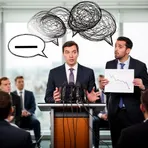
Unclear words that avoid saying something directly

To speak or act to hide the truth and avoid a clear answer

To avoid a direct answer by being unclear on purpose

To speak in a vague or praising way to avoid answering

To change the topic on purpose to avoid a subject

To avoid taking responsibility by lying or being vague

Treat a problem as less important to avoid dealing with it

To ignore or hide problems instead of dealing with them

To avoid saying something directly by talking a long time before answering
Antonyms


How Evasive

Surface Forms
Morphology
The meaning 'to avoid addressing a problem or question' is directly and transparently composed from 'fudge' (to dodge or evade verbally) plus 'issue' (a problem or question), with 'the' functioning as a determiner. Because the verbal sense of 'fudge' maps naturally onto evasive treatment of an issue, a B1 learner who knows the constituent words should be able to infer the MWE meaning.
Etymology
Fudge the issue comes from the picture of putting soft fudge over a problem to hide its rough parts, so you smooth it instead of dealing with it. That's why it now means 'to avoid' a question or be 'vague'.