

fruit bat
 5
3.7
5
3.7

- noun
- /frut bæt/
- The fruit bats of Montserrat have had to contend with most of nature's torments.
- nosed fruit bat
- pig-nosed fruit bat
- fruit bat populations
Examples
-
And we were able to capture nearly three and a half times more fruit bats last summer than we had during the peak of volcanic activity in 1997.
Academic text (2003) -
Many fruit bat populations suffered primarily because there was nowhere for them to go.
Academic text (2003) -
I was raised by African fruit bats.
-
The most likely source of horse infection was fruit bats.
Academic text (2015) -
My 2002 census of Montserrat's fruit bats followed the wettest spring since 1995.
Academic text (2003) -
Since that time, the fruit-bat population has rebounded and stabilized, but not without complications.
Academic text (2003) -
In Malaysia, a virus called Nipah spilled over from fruit bats in 1998.
Blog text (29) -
The rain, the dramatic rejuvenation of Montserrat's remaining forested areas, and a great increase in fruit bat populations are all most welcome.
Academic text (2003) -
In Puerto Rico, fruit bat populations could abandon hurricane-damaged forests and disperse across a larger landmass into unscathed areas.
Academic text (2003) -
The fruit bat hangs upside down in the tree, eating a ripe mango.
Synonyms
 1
8.1
1
8.1
A large bat that eats fruit and lives in warm areas


 1
8.2
1
8.2
A large bat that eats fruit and has a face like a fox and long wings

A large fruit bat with a face like a fox that lives in tropical regions

A large fruit-eating bat from Southeast Asia that is active at night

A group of fruit bats from New Guinea and nearby islands with tube-shaped nostrils

A bat that eats fruit and has tube-shaped nostrils that point away from each other

A fruit bat with nostrils that stick out like small tubes

A fruit-eating bat with tube-shaped nostrils that point outward
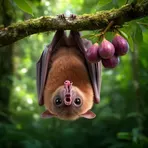
A fruit bat with nostrils shaped like tubes

A group of short-nosed fruit bats found in South and Southeast Asia

A bat that eats fruit and lives in South and Southeast Asia
Surface Forms
Morphology
The noun–noun compound 'fruit bat' is fully compositional: it denotes a bat that eats fruit, so a learner who knows 'fruit' and 'bat' can readily deduce the meaning. This straightforward modifier-head pattern is cross-linguistically common and follows normal English compounding, making the expression immediately comprehensible to B1 learners.
Etymology
Fruit bat: The name fruit bat comes from a simple image: a bat that eats fruit, often feeding on mangoes or figs at night. So the name means 'a bat that eats fruit' and helps you remember what this animal eats.