
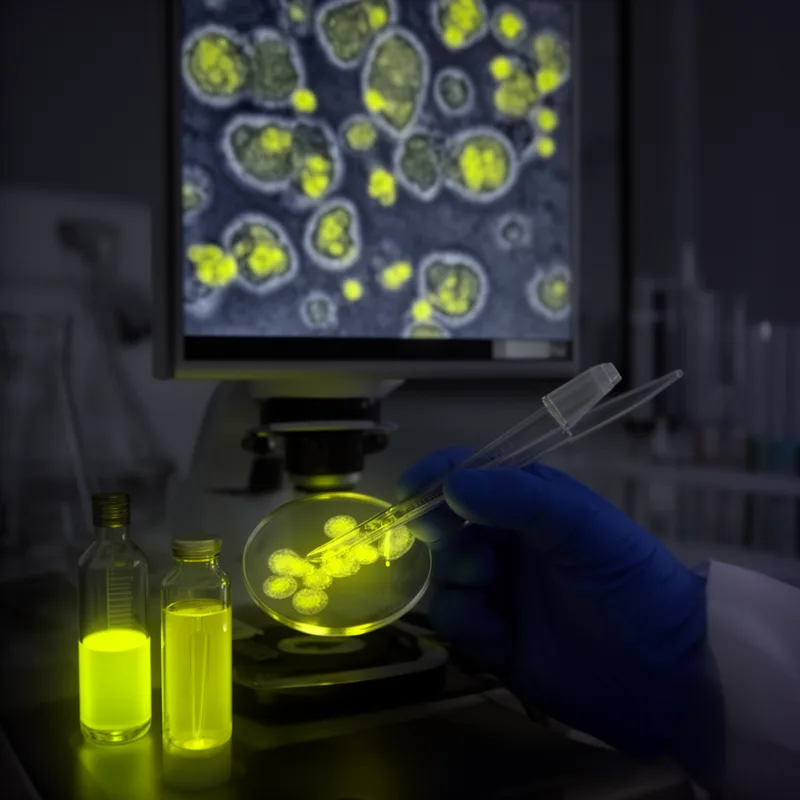
fluorescein isothiocyanate
- noun
- /flɔːˈrɛs.iˌin aɪ.soʊˌθaɪ.oʊˈkaɪ.ən.eɪt/
- Specialized
- We used fluorescein isothiocyanate to label the antibodies for the immunofluorescence microscopy study.
- fluorescein isothiocyanate-labeled
Examples
-
The secondary antibody was a fluorescein isothiocyanate-labeled goat antihuman IgG.
Academic text (2010) -
We used FITC (fluorescein isothiocyanate)-avidin D to label DNA strand breaks.
Academic text (2014) -
The Fluorescein isothiocyanate (FITC)-conjugated phalloidin (1:1,000) was added to the cells at 4 degrees C overnight.
Academic text (2018) -
NMJ changes were decorated with fluorescein isothiocyanate-labeled a-bungarotoxin (Invitrogen) and phalloidin as a control using the manufacturer's recommended protocol.
Academic text (2011) -
The fluorescein isothiocyanate dye emitted a bright green glow under the UV light during the experiment.
-
For the analysis, the researchers prepared a sample stained with fluorescein isothiocyanate to visualize protein localization.
Synonyms
A bright green dye that attaches to antibodies to make proteins glow under a fluorescence microscope

A chemical that glows under a microscope to stain cells
Surface Forms
Morphology
This is a technical compound name formed by straightforwardly combining 'fluorescein' (a dye that fluoresces) with 'isothiocyanate' (a chemical functional group), so a learner who knows both components can infer it refers to a fluorescent isothiocyanate derivative. However, the exact chemical relation and specific application (e.g., antibody labeling, yellow-green emission) are specialized and not fully predictable for a B1 learner, so the transparency is only partial.
Etymology
Fluorescein isothiocyanate tells a simple story: fluorescein is a yellow-green dye that 'glows' and isothiocyanate is the part that 'sticks' to proteins or antibodies. That's why the name means a glowing tag used to 'label' antibodies so scientists can see them under the microscope.

