
isothiocyanate


 1
9.9
1
9.9
- noun
- /ˌaɪsoʊˌθaɪoʊˈsaɪəˌneɪt/
- Specialized
- The secondary antibody was a fluorescein isothiocyanate-labeled goat antihuman IgG.
- fluorescein isothiocyanate
Loading YouTube…
Watch on YouTubeIn fact, my smoothie recipe has been designed to maximize, not minimize, for the isothiocyanate content.
- In fact, my smoothie recipe has been designed to maximize, not minimize, for the isothiocyanate content.
Examples
-
NMJ changes were decorated with fluorescein isothiocyanate-labeled a-bungarotoxin (Invitrogen) and phalloidin as a control using the manufacturer's recommended protocol.
Academic text (2011) -
The Fluorescein isothiocyanate (FITC)-conjugated phalloidin (1:1,000) was added to the cells at 4 degrees C overnight.
Academic text (2018) -
So the isothiocyanates have this N double bond C double bond S group.
-
In fact, my smoothie recipe has been designed to maximize, not minimize, for the isothiocyanate content.
-
We used FITC (fluorescein isothiocyanate)-avidin D to label DNA strand breaks.
Academic text (2014) -
Sulforaphane (SFN) is an abundant bioactive isothiocyanate found in broccoli and broccoli sprouts and is an important chemopreventive agent.
Academic text (2017) -
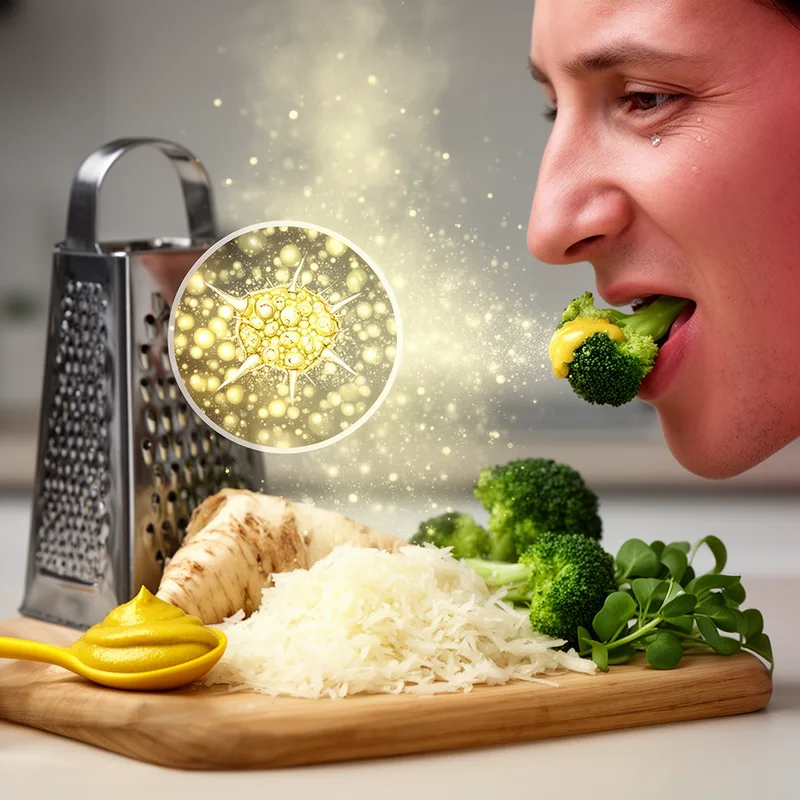
Many vegetables, including broccoli and mustard, contain isothiocyanate, which gives them their distinct flavor.
-
Cooking methods can influence the levels of isothiocyanate found in cruciferous vegetables.
-
Research shows that isothiocyanate compounds can help reduce the risk of certain cancers.
Compounds

- Specialized
A yellow-green dye that shines under a microscope and is used to mark proteins or antibodies
Surface Forms
Morphology
isothiocyanate = thiocyanate (opaque) = iso + thiocyanate
The morphological segmentation iso- + thiocyanate is regular, but the semantic distinction is technical (referring to an isomer) and not inferable by an average B1 learner.
Etymology
The word isothiocyanate comes from three parts: iso- 'equal', thio- 'sulfur', and cyanate, from cyan 'blue'. So, an isothiocyanate is a type of chemical with a sulfur next to a carbon-and-nitrogen part, and that mix is what gives mustard and horseradish their sharp taste.