
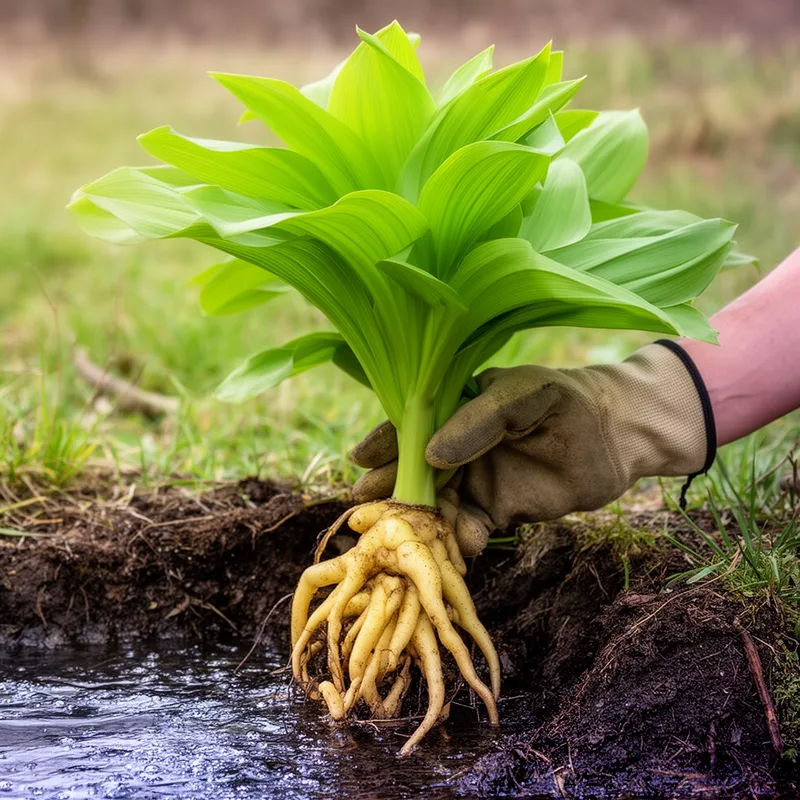
false hellebore
- noun
- /fɔls ˈhɛlɪbɔr/
- Specialized
 :
heleboro falso
:
heleboro falso
- False hellebore contains toxic compounds that can be harmful if ingested.
Examples
-
Gardening experts warn that false hellebore should be planted with caution due to its poisonous rhizomes.
-
Corn lily, or false hellebore, which usually grows along rivulets in the meadow, gets its name from its large, strongly veined leaves that resemble green corn husks.
Academic text (1998) -
False hellebore
Blog text (29) -
The thick leaves of the false hellebore can be mistaken for those of edible plants, leading to potential poisoning.
Synonyms

A group of large poisonous plants with thick leaves that live for several years in cool regions
A North American plant with large leaves and greenish flower clusters that is poisonous and used carefully in medicine

A North American plant with large leaves and yellow-green flowers that is poisonous
Surface Forms
Morphology
The term is a direct composition of 'false' (not genuine or imitation) and 'hellebore' (a plant), so a learner who knows both constituents will infer it denotes a plant that resembles or is mistaken for true hellebore but is not the genuine species. The 'false X' naming pattern for plants is a common, cross-linguistic compositional strategy, making the meaning predictable to B1 learners.
Etymology
False hellebore comes from the plant looking very like the real hellebore but not being the same. The word false shows it is a lookalike and is often 'poisonous', so the name warns people not to eat it.

