

facial nerve
 2
5.5
2
5.5

- noun
- /ˈfeɪʃəl nɜrv/
- Specialized
- Currently, we do not know the exact cause of facial nerve stimulation.
- facial nerve injury
- facial nerve stimulation
- facial nerve schwannoma
Examples
-
However, because of a recurrence of persistent facial nerve stimulation, she was forced to stop using the device.
Academic text (1999) -
In 79% of the procedures, the facial nerve was not identified at the time of surgery.
Academic text (1996) -
The key to the preservation of the integrity of the facial nerve is knowing where it lies.
Academic text (1996) -
The patient recovered from surgery without facial nerve weakness or any other complications.
Academic text (2008) -
The energy of the fracture is directed away from the facial nerve at the skull base.
Academic text (2008) -
The patient had a normally functioning facial nerve and no otologic abnormalities.
Academic text (2008) -
Residual cholesteatoma is often found during surgery for facial nerve repair, which supports the opinion.
Academic text (1996) -
External factors that are important in the prevention of facial nerve injuries are residency, fellowship, and peer review.
Academic text (1996) -
Iatrogenic injuries to the facial nerve often result in lawsuits with substantial financial settlements.
Academic text (1996) -
The surgeon carefully examined the facial nerve to avoid damaging it during the procedure.
Synonyms

A nerve that moves the muscles of the face
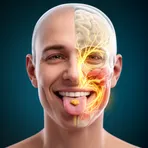
A nerve in the head that controls the muscles of the face and taste at the front of the tongue
How Functional
- Specialized
2
5.5

- US

 1
4.2
1
4.2
Surface Forms
Morphology
The meaning is directly compositional: 'facial' = related to the face and 'nerve' = a bundle of nerve fibers, so a learner who knows both words can infer it is a nerve serving the face. While full clinical specifics (e.g. 'seventh cranial nerve' and detailed motor/sensory functions) are specialized knowledge, the basic referent is immediately transparent to a B1 learner.
Etymology
Facial nerve names the nerve that controls the face. The word facial points to the face and the word nerve is like the body's 'wire' that carries messages, so the name explains why this nerve makes the face 'move' and sends some 'feeling' to the brain.