
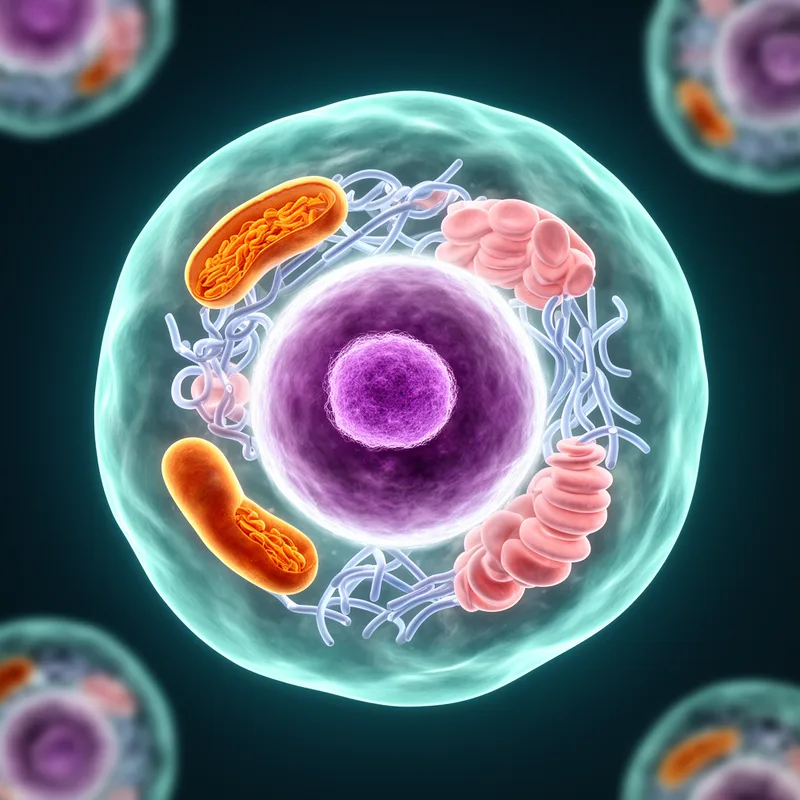
eukaryotic
 2
7.5

- adjective
- /juːˌkɛrɪˈɒtɪk/
- Specialized
- For those early eukaryotic cells—cells with a nucleus—survival long enough to reproduce was almost a miracle.
- eukaryotic cells
- eukaryotic genetics
- eukaryotic genes
Loading YouTube…
Watch on YouTubeFrom the first eukaryotic cells to the first multicellular organisms, to plants to flowering trees, like the world got more and more and more alive.
- From the first eukaryotic cells to the first multicellular organisms, to plants to flowering trees, like the world got more and more and more alive.
- This is how you go from single cell eukaryotic to prokaryotic or the other way around.
- Not bacteria, but single celled eukaryotic organisms and more larger and more complex cells that make up bodies like ours, things like paramecia.
- When you went from the prokaryotes to eukaryotic cells and then they started making groups and when you make a certain group, you make a you, you make it sound.
Examples
-
Most of these genes occur in eukaryotic cells, but not in bacteria or archaea.
Blog text (31) -
So we had the evolution of the eukaryotic organisms, unicellular still, right.
-
These are cells that consist of eukaryotic features just like our own cells.
-
The above examples involve eukaryotic cells that form the basis of multicellular life.
Academic text (2012) -
The schematic shows the various steps a foreign bacterial sequence may take when becoming functional in a eukaryotic genome.
Academic text (2018) -
The sequences at the ends of eukaryotic chromosomes, called telomeres, are composed of hundreds or thousands of short DNA repeats.
Academic text (1998) -
Densely packed around the photocyte margins are mitochondria, the oxygen-consuming power plants that occur in nearly all eukaryotic cells.
Academic text (2003) -
Mitochondria, membrane-bound organelles found in all eukaryotic organisms, are essential for energy production.
-
The study of eukaryotic cells has led to important advancements in biotechnology and medicine.
-
Unlike prokaryotic cells, eukaryotic cells contain a true nucleus and various specialized organelles.
Synonyms

 1
8.1
Having cells with a nucleus covered by a membrane and small parts that do jobs inside the cell
Antonyms
- Specialized
1
8.1
Having cells that do not have a nucleus or other parts covered by a membrane
How Complex

Surface Forms
Morphology
eukaryotic = eukaryote (semi-transparent) = eu + kary + ic
The adjectival formation from the noun 'eukaryote' using the productive '-ic' is regular and predictable.
Etymology
Eukaryotic comes from the Greek parts eu- meaning 'good' or 'true' and karyon meaning 'nut' or 'kernel', like the English word kernel. So a eukaryotic cell is a cell with a 'true kernel' — a nucleus wrapped in a membrane, which is why eukaryotic organisms have cells with a clear nucleus and other internal parts.