
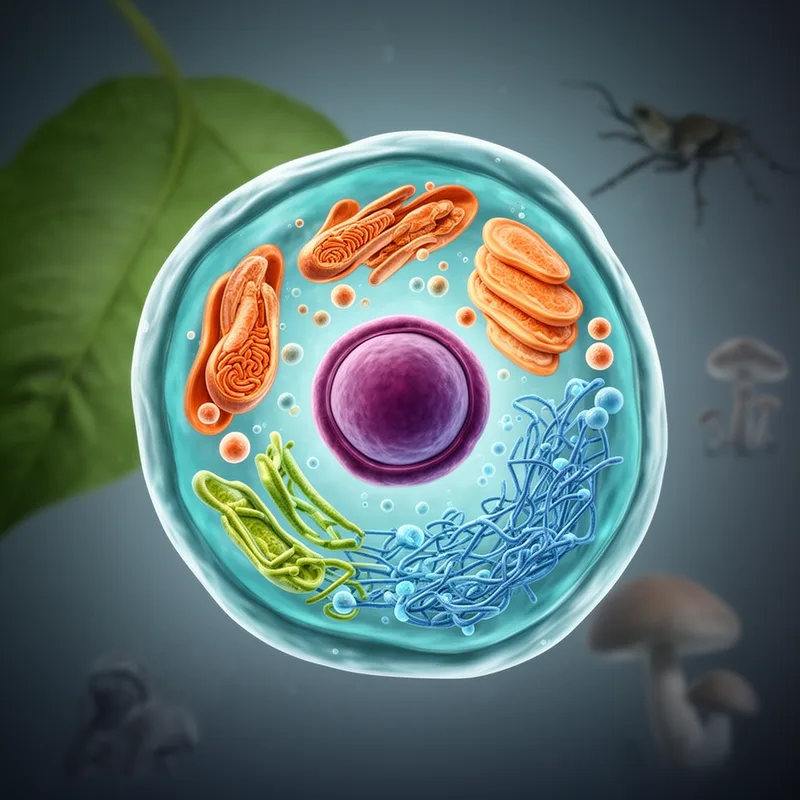
eucaryotic


 1
8.1
- adjective
- /juːˌkɛr.iˈɒt.ɪk/
- UK
- The presence of a true nucleus distinguishes eucaryotic cells from prokaryotic ones.
Examples
-
Fungi are classified as eucaryotic because their cells contain membrane-bound organelles.
-
The presence of a true nucleus distinguishes eucaryotic cells from prokaryotic ones.
-
All plants and animals are eucaryotic organisms with complex cellular structures.
-
The eucaryotic cells in plants have complex structures.
-
Are all eucaryotic organisms multicellular?
-
All plants and animals are eucaryotic organisms with complex cellular structures.
-
Fungi are classified as eucaryotic because their cells contain membrane-bound organelles.
Synonyms
 2
7.5
Cells that have a nucleus and other parts inside a membrane
Antonyms
- Archaic
1
8.5
Having cells that do not have a membrane around their nucleus, like bacteria
How Complex

Surface Forms
Morphology
eucaryotic = eucaryote (semi-transparent) = eu + caryote + ic
Forming the adjective from the noun 'eucaryote' by adding the productive suffix '-ic' is a regular and identifiable derivation.
Etymology
Eucaryotic comes from Greek parts eu- meaning 'true' or 'good' and karyon meaning 'kernel' or 'nut', which you can think of like the kernel of a seed. So a eucaryotic cell is one with a 'true' kernel — a real nucleus inside a membrane, which is why the word describes cells with a definite nucleus.