

eukaryote
 2
8.2
2
8.2

- noun
- /juˈkɛrɪoʊt/
- Specialized
- Plant material represents an enormous amount of the biomass of Earth, and many eukaryotes have evolved to feed on both living and dead plants.
- unicellular eukaryotes
- eukaryotes, including plants
- first eukaryotes
Loading YouTube…
Watch on YouTubeIt's single cell prokaryotes and eukaryotes, but they're not, they're boring.
- It's single cell prokaryotes and eukaryotes, but they're not, they're boring.
- And so what's found if trnas are compared between bacteria, eukaryotes, Archaea, there's evolutionary divergent.
- It's same exact steps, but it can get more crowded as we get closer to eukaryotes, for instance.
- But they are living, breathing eukaryotes.
- So, you know, we commonly think of eukaryotes in the gut as, as you know, something like a parasite.
Examples
-
For example, herbivorous eukaryotes must cope with complex mixtures of toxic compounds that are produced by plants.
Academic text (2018) -
However, studies indicate that the Archaea are related specifically to eukaryotes, including plants and animals.
Academic text (2000) -
In the early 1990s, circRNAs in higher eukaryotes were discovered.
Academic text (2017) -
In this review, we discuss these recent findings, aiming to incorporate examples from a wide diversity of eukaryotes.
Academic text (2018) -
Eukaryotes have evolved numerous strategies to respond to a diverse range of environmental insults.
Academic text (2017) -
Now here's a fairly simple multicellular eukaryote, a caddis fly larva.
-
Scientists studied eukaryotes, including animals and plants, to better understand their complex cell structures.
-
The group of eukaryotes consists of organisms with cells that contain a nucleus and specialized organelles.
-
Researchers have identified numerous eukaryotes in the rainforest, highlighting the diversity of life forms present there.
Synonyms
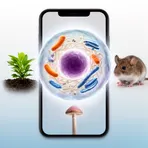
A living thing whose cells have a nucleus inside a membrane like plants and animals
Antonyms

Surface Forms
Morphology
eukaryote = karyote (opaque) = eu + kary + ote
The parts are Greek scientific combining forms ('eu-' and 'kary-') that are unfamiliar to average learners, so the meaning is not derivable by a typical B1 learner.
Etymology
Eukaryote comes from Greek parts eu- meaning 'true' or 'good' and karyon meaning 'kernel' or 'nut', so imagine a small kernel sitting inside each cell. So a eukaryote is an organism whose cells have a clear, separate 'nucleus' like a protected kernel inside the cell.