
eosinophilia


 1
9.9
- noun
- /ˌiːəˌsɪnəˈfɪliə/
- Specialized
- The minor criteria include asthma, unilateral predominance, radiographic bone erosion, fungal culture, Charcot-Leyden crystals, and serum eosinophilia.
- elevated eosinophilia
- airway eosinophilia
- blood eosinophilia
Examples
-
Eosinophilia is associated with numerous disorders, but most often relates to atopic diseases and hypersensitivity phenomena.
Academic text (2007) -
We report the diagnostic difficulties involved in an HIV-infected patient with prolonged diarrhea associated with eosinophilia.
Academic text (2007) -
In laboratory findings analysis, eosinophilia was seen in all cases.
Academic text (2007) -
The results of hematologic tests are usually unremarkable, although eosinophilia might be present.
Academic text (2002) -
Kimura disease is associated with eosinophilia and an increased level of serum IgE.
Academic text (2010) -
In the absence of skin disease, eosinophilia in HIV infection may relate to other conditions such as parasitic infection and drug hypersensitivity.
Academic text (2007) -
The late asthmatic reaction is associated with blood and sputum eosinophilia and airway hyper-responsiveness.
Academic text (2000) -
Crisp and co-authors conclude that the appearance of eosinophilia in rheumatoid disease may indicate a more aggressive course with extra-articular complications.
Academic text (2007) -
In addition to several autoimmune abnormalities, patients presented with elevated IgE, eosinophilia, dermatitis, and food allergies; all of which are type 2 immunity dependent.
Academic text (2016) -
Eosinophilia can often indicate an eosinophilia allergic reaction or parasitic infection.
How Many
- Specialized
1
9.9

- Specialized
Surface Forms
Morphology
eosinophilia = eosinophil (opaque) = eosin + phil + ia
The formation is a regular medical derivation: the noun 'eosinophil' takes the condition-forming suffix '-ia' to mean a state of (increased) eosinophils.
Etymology
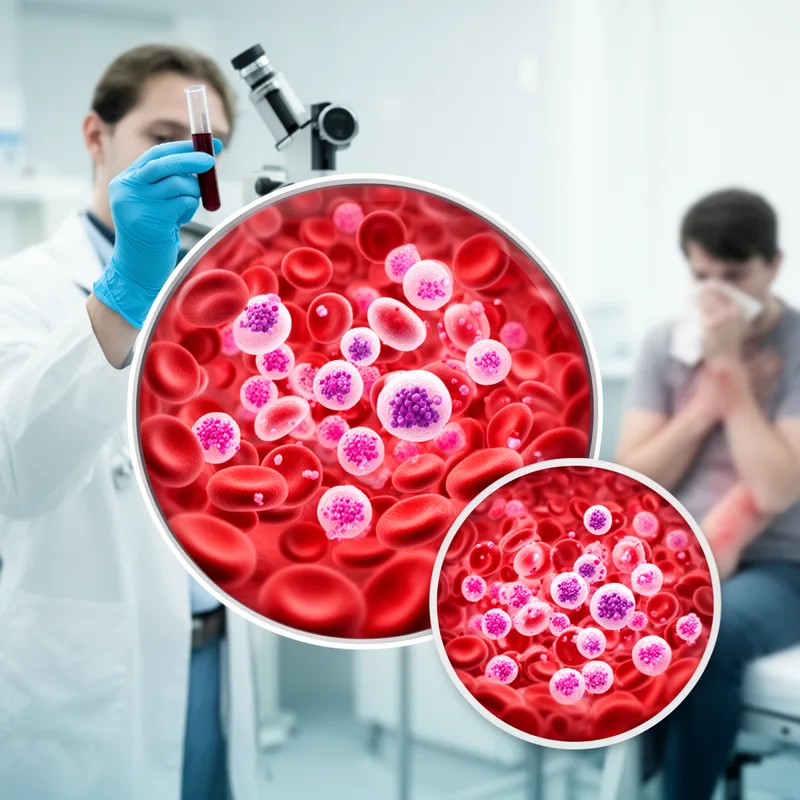
Eosinophilia comes from eosin, a pink dye named from a Greek word meaning 'dawn', and -philia, meaning 'love', as in philosophy ('love of wisdom'). So eosinophilia describes having too many white blood cells that 'love' eosin and turn pink, which is what doctors see in some allergies and infections.