
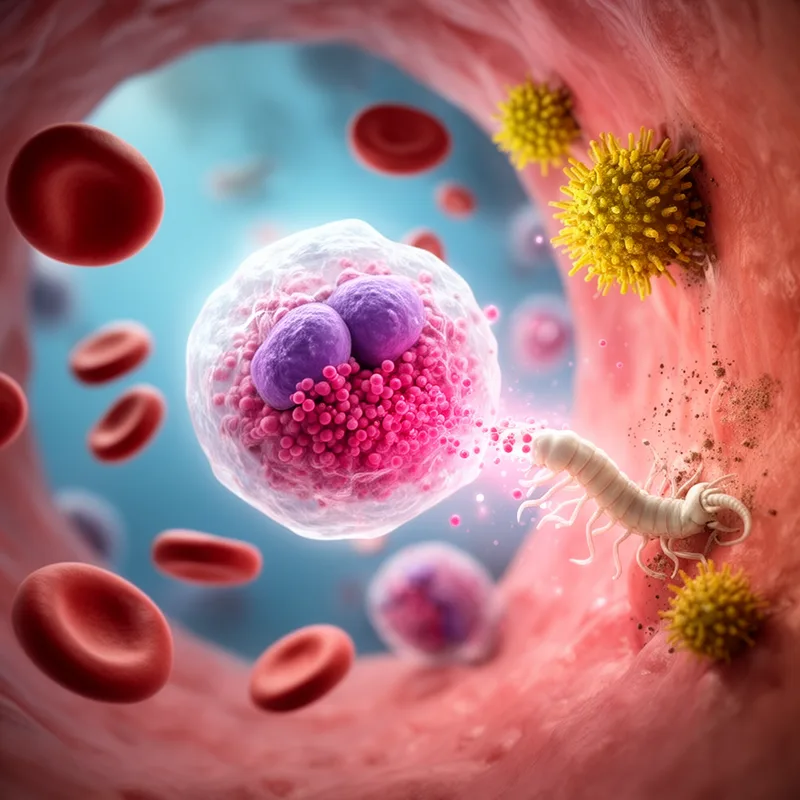
eosinophil
 2
7.5

- noun
- /ˌiːəˈsɪnəfɪl/
- Specialized
- In allergic reactions, the number of eosinophils in the blood can increase significantly.
- blood eosinophils
- sputum eosinophils
- eosinophil count
Loading YouTube…
Watch on YouTubeHow is our eosinophil, you know, specialized in killing these parasites?
- How is our eosinophil, you know, specialized in killing these parasites?
Examples
-
Allergic asthma is characterized by inflammation involving the accumulation of eosinophils and mononuclear cells in the airways.
Academic text (2000) -
An increased number of eosinophils has been found in nasal polyps of aspirin-sensitive patients with asthma.
Academic text (1999) -
How is our eosinophil, you know, specialized in killing these parasites?
-
As shown in Figure 2, this suppression of eosinophil numbers was maintained up to 16 weeks after the dose.
Academic text (2000) -
At the follow-up visit four weeks after the last injection, blood eosinophil counts had returned to baseline in both groups.
Academic text (2000) -
Clearly, further studies are needed to establish the potential role of eosinophils as biomarkers for optimizing COPD treatment.
Academic text (2017) -
However, our findings question the role of eosinophils in mediating the late asthmatic response and causing airway hyper-responsiveness.
Academic text (2000) -
The eosinophil plays a crucial role in the body's defense against parasitic infections.
-
Doctors often monitor eosinophil levels to evaluate a patient's allergic responses.
Synonyms
A white blood cell that helps fight parasites and appears during allergic reactions
Surface Forms
Morphology
Etymology
The word eosinophil comes from eosin, a pink dye named after the Greek word for 'dawn', and -phil, a part meaning 'loving', like in philosophy, which means 'love of wisdom'. So an eosinophil is a cell that 'loves' the pink dye and therefore looks pink under the microscope, which is why doctors call these blood cells by that name.