
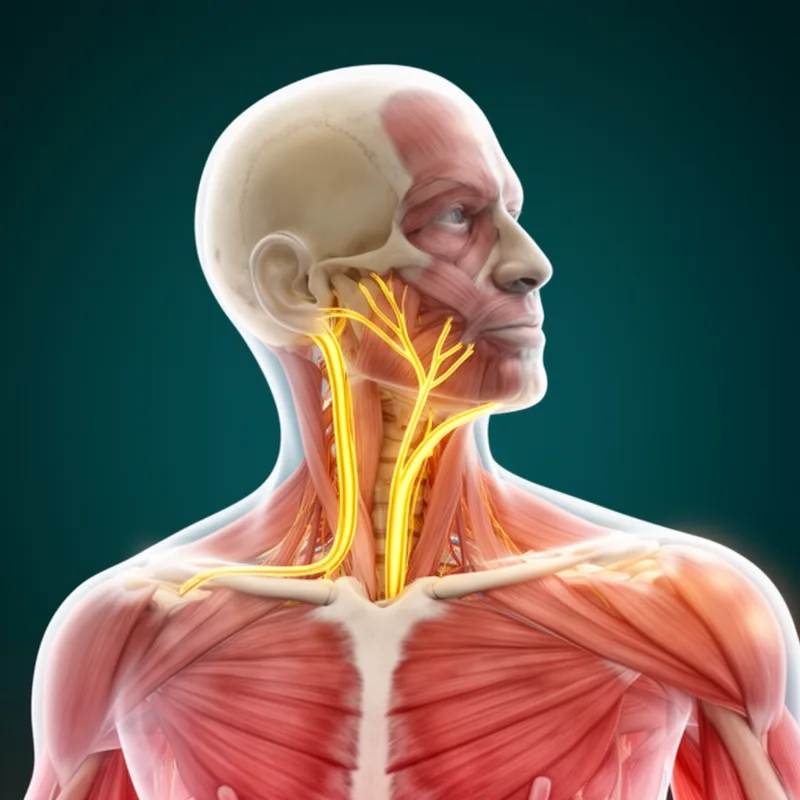
eleventh cranial nerve
- noun
- /ɪˈlɛvənθ ˈkreɪniəl nɜrv/
- Specialized
- Injury to the eleventh cranial nerve may affect head rotation and shoulder elevation.
Examples
-
The surgeon identified the eleventh cranial nerve during the neck dissection.
-
Doctors often examine the eleventh cranial nerve during neurological assessments.
-
Damage to the eleventh cranial nerve can lead to weakness in the shoulder muscles.
-
The eleventh cranial nerve is crucial for neck movement.
-
Damage to the eleventh cranial nerve can lead to weakness in the shoulder muscles.
-
Injury to the eleventh cranial nerve may affect head rotation and shoulder elevation.
-
The surgeon identified the eleventh cranial nerve during the neck dissection.
Synonyms


 1
7.7
1
7.7
A nerve that controls some neck and shoulder muscles
 1
7.9
1
7.9
A nerve that controls some muscles in the neck and shoulder

A nerve from the head and spine that controls neck and shoulder muscles
Surface Forms
Morphology
The phrase is a straightforward compositional label: 'eleventh' (ordinal) + 'cranial' (relating to the skull) + 'nerve' (a nerve) yields 'the nerve number eleven associated with the cranium.' Although the term is technical and a learner might not know its detailed function, the referent (the 11th cranial/accessory nerve) is directly derivable from the constituent words and standard anatomical naming, so a B1 learner who knows the parts can grasp the basic meaning.
Etymology
Eleventh cranial nerve is a name that shows this nerve is number 11 in the group of nerves from the head: eleventh means 11, cranial means from the head, and nerve is a body part that sends messages. It is also called the 'accessory nerve' because it works like an extra helper to move neck and shoulder muscles, so the name tells you where it is and what it does.