

spinal accessory


 1
7.9
1
7.9
- noun
- /ˈspaɪnəl əkˈsɛsəri/
- Specialized
- In a surgical procedure, the surgeon carefully identified the spinal accessory nerve to avoid damaging it.
- spinal accessory nerve
Examples
-
However, information is limited on electrophysiologic monitoring of the spinal accessory nerve (SAN) during modified radical neck dissection.
Academic text (2006) -
The doctor explained how the spinal accessory nerve helps lift the shoulders and turn the head.
-
Weakness in the trapezius muscle can indicate an issue with the spinal accessory nerve.
Synonyms
 1
7.7
1
7.7
A nerve that controls some neck and shoulder muscles
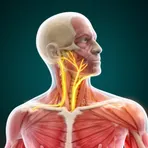
A nerve that helps move the head and lift the shoulder

A nerve from the head and spine that controls neck and shoulder muscles
Surface Forms
Morphology
The parts 'spinal' (relating to the vertebral column) and 'accessory' (auxiliary) give a learner a loose, compositional sense—an auxiliary structure related to the spine—but they do not specifically indicate 'the eleventh cranial nerve' or even that the item is a nerve. Because this is a technical anatomical term that requires domain knowledge to recover the precise referent, it is partially but not fully predictable to a B1 learner.
Etymology
The noun spinal accessory is the name for a 'nerve' that has parts coming from the spinal cord and from the head, so the word accessory shows it is an extra link between them. That's why spinal accessory refers to the nerve that helps the neck and shoulder muscles move.