

electrophoresis
 2
8.4
2
8.4

- noun
- /ɪˌlɛk.trə.fəˈriː.sɪs/
- Specialized
- A PCR product of 140 bp was detectable after electrophoresis on a 2% agarose gel.
- gel electrophoresis
- agarose gel electrophoresis
- polyacrylamide gel electrophoresis
Examples
-
PCR products were analyzed by electrophoresis on 2% agarose gels, followed by ethidium bromide staining.
Academic text (1992) -
The amplified product was analyzed by electrophoresis on a 2% agarose gel after ethidium bromide staining.
Academic text (2012) -
The DNA pieces are sorted according to size by a sieving technique called electrophoresis.
Academic text (1995) -
Indirect procedures often use electrophoresis to analyze the distribution of isozyme variants within and between populations.
Academic text (2002) -
We used melting curve analysis and agarose gel electrophoresis to verify the correct PCR products.
Academic text (2012) -
The amplicons were resolved by agarose gel electrophoresis at 200 volts for 40 minutes.
Academic text (2002) -
The amplified product was found to be 836 base pairs (bps) long on electrophoresis gel.
Academic text (2014) -
Once identified, microsatellites are amplified using the polymerase chain reaction and sized using gel electrophoresis or an automated sequencer.
Academic text (2010) -
The PCR products were stained with ethidium bromide and examined after electrophoresis through a 1.5% agarose gel.
Academic text (2012) -
Scientists commonly use electrophoresis to separate DNA fragments for genetic analysis.
Synonyms

Movement of charged particles in a liquid toward opposite ends under an electric field

Tiny charged particles move through a liquid because of an electric field

Movement of charged particles in a liquid, positives moving to the negative pole and negatives moving to the positive pole
Compounds

- Specialized
A way to separate substances on filter paper using electric current to study them
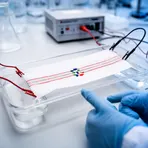
- Archaic
A way of using filter paper to separate molecules by running an electric current through it
How Effective
- Specialized

 1
7.5
1
7.5

- Specialized
1
7.2
- Specialized
2
8.4
- Archaic
Surface Forms
Morphology
electrophoresis = phoresis (opaque) = electro + phoresis
The word is built from the combining form 'electro-' plus the technical noun 'phoresis', but the full scientific meaning is not recoverable for an average B1 learner from standard English morphology.
Etymology
The word electrophoresis breaks into electro- ('electric') and -phoresis ('to carry' or 'move'), so it literally means 'electric carrying'. That's why electrophoresis is a way that uses an electric field to move and separate charged particles in a liquid or gel.