

carrier electrophoresis
- noun
- /ˈkæriər ɪˌlɛktrəˈfɔrɪsɪs/
- Specialized
- Results indicated that carrier electrophoresis provided clear separation of amino acids on the filter paper.
Examples
-
The laboratory used carrier electrophoresis to separate the proteins found in the sample.
-
Advances in carrier electrophoresis have made it easier to analyze complex biochemical mixtures.
-
The lab used carrier electrophoresis to analyze protein samples.
-
Can carrier electrophoresis help identify unknown compounds?
-
Recent studies show that carrier electrophoresis can effectively separate biomolecules like proteins and nucleic acids during analysis.
-
Researchers demonstrated that carrier electrophoresis significantly improved the resolution of chromatographic analyses on paper.
-
In biochemistry labs, carrier electrophoresis is commonly employed to examine the purity of protein preparations.
Synonyms

 2
8.4
2
8.4

Movement of charged particles through a gel using electricity to separate molecules such as DNA and proteins
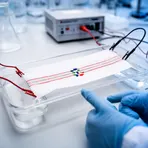
A way of using filter paper to separate molecules by running an electric current through it
Surface Forms
Morphology
The noun-noun combination is compositionally predictable: 'carrier' specifies the kind of 'electrophoresis' (i.e. electrophoresis that uses a carrier material). Although technical, the meaning follows directly from the constituents, so a learner who knows both words can infer the MWE's sense.
Etymology
The noun carrier electrophoresis comes from a simple lab image: a carrier such as filter paper holds the sample while electrophoresis is movement by electricity that makes different parts travel at different speeds. That's why the name describes a way to make a mix 'separate' into its parts.